
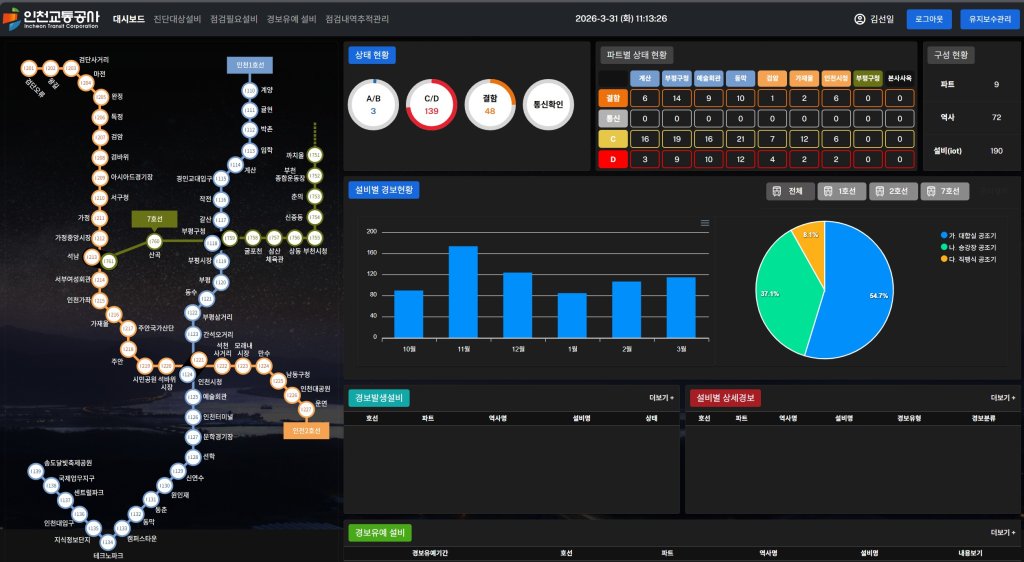
Subway HVAC systems were mostly managed after failures or through routine inspections, leaving gaps in reliability and station air-quality control. Incheon Transit Corporation built an AIoT platform that uses vibration and noise sensors with AI analytics to detect early warning signs and support maintenance decisions. It is innovative because it combines predictive diagnosis, maintenance history and parts-cycle management in one operational platform.
Innovation Summary
Innovation Overview
Incheon Transit Corporation built an AIoT-based predictive maintenance and smart maintenance platform for subway HVAC systems to improve operational reliability and manage underground-station air quality more systematically. The previous approach relied largely on corrective repairs after breakdowns or periodic inspections, which limited early detection and preventive action. Because HVAC performance directly affects passenger comfort and service quality, a more precise and predictive maintenance model was needed.
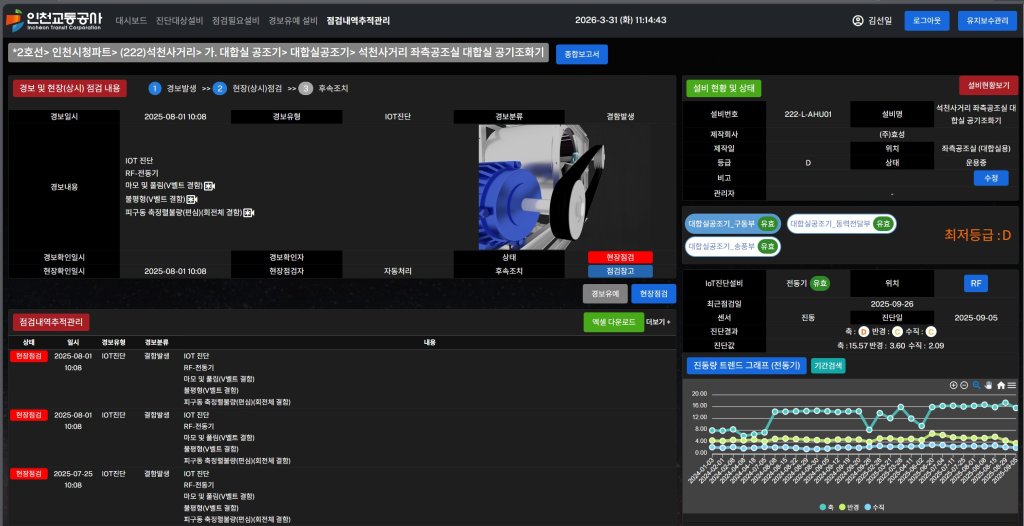
The platform uses IoT vibration and noise sensors, gateways, wireless transmission and server-based monitoring to diagnose equipment conditions in real time, detect fault signs and estimate remaining useful life. It also integrates mobile maintenance-history management, average replacement-cycle analysis for major parts and remote access to technical documents. By combining predictive maintenance with smart maintenance functions in one platform, the system goes beyond monitoring and supports data-driven maintenance across the full workflow.
The project aims to prevent unexpected failures, optimise station air-quality management, improve and standardise maintenance work, and build a foundation for the digital transformation of railway mechanical facilities. It was expanded in stages after a testbed and performance verification: Line 1 in 2021, Line 2 in 2023, and Line 7 in 2025-2026. By 2024, the platform had been applied to 190 HVAC units on Lines 1 and 2, and 28 more units on the Bucheon section of Line 7 are being added.
The main beneficiaries are subway passengers and maintenance staff. Passengers benefit from a more comfortable station environment and more stable HVAC service, while staff gain real-time diagnostics, remote inspection, history analysis and parts-cycle management tools. The corporation plans to extend the platform to additional sections and extensions of Line 7 and further improve prediction accuracy and practical use through accumulated data.
Innovation Description
What Makes Your Project Innovative?
The main innovation is the shift from reactive, breakdown-based maintenance to predictive management that identifies warning signs before failure. Rather than relying only on routine inspections, the project continuously collects vibration and noise data, analyses equipment condition and remaining life, and connects the results to remote monitoring and field maintenance-history management. It is distinctive because diagnosis, history management, parts-cycle analysis and technical-document control are integrated in one platform.
The project is also innovative in scale and institutionalisation. It moved beyond a pilot at one site, expanded from Line 1 to Line 2, and is now being rolled out on Line 7. By combining AIoT, big data and mobile maintenance functions in an operating railway environment, it offers a practical and expandable public-sector model for smart infrastructure maintenance.
What is the current status of your innovation?
The system has been completed for Lines 1 and 2 and is now being expanded to Line 7. By 2024, it had been installed on 190 HVAC units on Lines 1 and 2. In 2025-2026, procurement, contracting and field installation are under way for 28 units across six stations on the Bucheon section of Line 7. Expansion to additional sections is planned, so implementation and diffusion are progressing together.
Innovation Development
Collaborations & Partnerships
Incheon Transit Corporation defined the operational problem and led the project, while private technology firms supplied sensors, gateways, analytics and system integration. KC Mirae Technology Co., Ltd., identified as a joint patent holder, acted as a key technology partner. Agreements with the Korean Society for Artificial Intelligence Education and AI Works also supported talent development and training, strengthening technical reliability, field applicability and future diffusion.
Users, Stakeholders & Beneficiaries
Direct users are maintenance staff, depots, mechanical teams and control personnel responsible for HVAC inspection and repair. They use the platform for remote checks, pre-inspection review and maintenance-history analysis. Stakeholders include the corporation's departments, partner companies and academic institutions supporting system development, training and diffusion. Final beneficiaries are subway passengers, who benefit from more comfortable stations and more reliable HVAC service.
Innovation Reflections
Results, Outcomes & Impacts
The innovation aims to improve HVAC reliability, manage underground-station air quality more systematically, and make maintenance work more efficient. Deployment has been completed on Lines 1 and 2 and is expanding to Line 7. By 2024, 190 HVAC units on Lines 1 and 2 had been equipped, and 28 additional units are being added on Line 7 in 2025-2026. The project has also produced two patents, five academic outputs and a 2024 Top 10 Railway Technologies award. Impact is evidenced by deployment scale, expansion, research and award results, and documented gains in work efficiency and station comfort.
Challenges and Failures
A major challenge was embedding a new technology in a live railway environment while expanding it line by line. The preparation phase required a testbed and performance verification, and the expansion phase faced differences in operating conditions and budget availability across lines. In particular, the Incheon section of Line 7 had not yet secured a budget, limiting immediate rollout. To manage this, the corporation used a phased strategy-preparation, Line 1, Line 2 and Line 7-reducing risk through verification, integrated monitoring and staged expansion.
Conditions for Success
Several conditions supported success. First, the project aligned closely with national policy directions such as the Basic Plan for Mechanical Equipment Development and measures to improve underground-station air quality, giving it a strong public rationale. Second, a phased approach-from testbed to verified expansion-built technical trust. Third, an integrated AIoT infrastructure combining sensors, communications, analytics, monitoring and mobile history management made field use practical. Fourth, collaboration among the public sector, companies and academia linked technology development, implementation and training.
Lessons Learned
First, public-facility maintenance reaches clear limits when it depends mainly on routine inspections and experience; data-driven predictive management improves effectiveness and sustainability. Second, new technology is better introduced through a testbed, performance verification and phased expansion than through one-time full deployment. Third, predictive maintenance is not achieved by sensors and algorithms alone; it must also include history management, parts-cycle analysis, manuals and training. Fourth, collaboration among public agencies, companies and academia strengthens both technical outcomes and diffusion potential.
Anything Else?
This innovation is more than a facility-management system; it is a scalable model for the digital transformation of railway maintenance. Two patents, five academic outputs and recognition among the 2024 Top 10 Railway Technologies show both technical maturity and external credibility. The establishment of a permanent training site and talent-development partnerships also indicates that the system is being embedded as an organisational capability rather than remaining a one-off project. It has strong potential for transfer to other metro operators and similar public infrastructures.
Supporting Videos
Status:
- Implementation - making the innovation happen
Innovation provided by:

Media:
Files:
Date Published:
29 September 2026