

The toolbox for designing digital services is intended to help public service owners, managers and other interested parties understand the design process and includes tools to make the process smooth. The process is described both in Estonian and English but tools are only in Estonian, which can be machine translated. The resource includes guidance on preparation and building a service team, understanding and choosing a focus, problem identification and solving, testing solutions, development of…
Publisher Type: National government

The Australian Public Service (APS) Framework for Engagement and Participation provides guidance, principles, and links to interactive tools that support public servants and managers to adopt and improve the participation and engagement of stakeholders and citizens as ways to earn trust and overcome complexity in dealing with society's challenges in the 21st century.
Public servants and managers are invited to subscribe to the principles that underpin this vision and actively use this toolkit…

The resource authors define responsible tech as applying an ethical approach when developing, using and distributing new technology in a way that contributes to an environmentally, socially and economically sustainable society.
The Responsible Tech: Self-Assessment Tool is an online tool that takes users through a series of structured questions in order to enhance a responsible approach to tech development work. The tool can be used in the intervention, development and distribution of new…
The Anticipatory Innovation Starter Kit (AISK) offers a step-by-step approach to access a set of methodologies and tools to solve organisational challenges in the area of anticipatory innovation governance. Developed by the Experimentation Lab for Public Administration (LabX), part of the Administrative Modernisation Agency (AMA) in Portugal, the starter kit intends to be an actionable tool to envisage and anticipate changes in public sector organisations.
Users start in a "Pool of Problems"…

Mission-oriented innovation aims to create change at the system level where everyone involved is involved and drives development. The working method is a tool for achieving jointly set sustainability goals on a broad basis and with great impact.
In this handbook, we tell about Vinnova's work together with a number of relevant actors to jointly create mission-oriented innovation. You can follow how the actors under 2019-2021 test and develop the working method in the two different areas of food…
The AIA is a questionnaire designed to help assess and mitigate the impacts associated with deploying an automated decision system. It helps identify the impact level of an automated decision system. It was developed with the Canadian Directive on Automated Decision-Making in mind but it can be applied elsewhere. The questions are focused on business processes, data, and system design decisions.
The questionnaire asks around 60 questions and the results will demonstrate impact level as well as a…

The Privy Council Office's Impact and Innovation Unit’s (IIU) developed this guidance for impact measurement, in support of its work under Impact Canada. This resource provides an introduction to the topic, as well as a reference for those involved in the design, delivery, procurement or appraisal of impact measurement strategies in Canada and beyond. It provides descriptions and considerations of different ways of measuring impact versus traditional methods.
It includes the reasoning for…


Australia's BizLab, within the Department of Industry, Innovation, and Science, was established in 2016 and launched BizLab Academy in 2018. The goal of the academy is to teach Human Centred Design (HCD) to department employees, but also the rest of the Australian Public Service. The academy aims to strengthen the public sector's capability for evidence-based policy and service design while at the same time instilling a citizen-centric culture and building an alumni of human centred design…
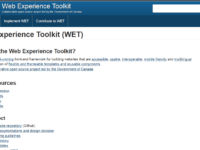
A front-end framework for building websites that are accessible, usable, interoperable, mobile friendly and multilingual for the Government of Canada and beyond, the resource includes a collection of of flexible and themeable templates and reusable components and related guidance. Content is also available in French.

X-Road, a data exchange layer for information systems, is a technological and organizational environment enabling a secure Internet-based data exchange between information systems. Source code of X-Road is open for all and it is licensed under MIT license.
Consultation services for deploying independent X-Road instances can be obtained from enterprises with such services. There is also an X-Road Community for support.
This is a collaborative project involving several countries/territories,…