Country Territory: United States
Liberating Structures is a web resource that includes a collection of 33 results-oriented collaboration patterns have been developed and refined through field testing over a 10+ year period in a variety of sectors including healthcare and business.
They are intended to complement conventional practices for organisational design and strategy design. They are designed to be used in an inclusive collaborative setting.
Associated books (for sale) and video guidance is available to assist those…
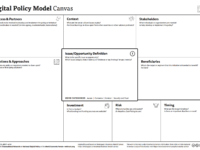
This canvas guides policy makers to derive specific policies and regulatory mechanisms in an agile and iterative manner – integrating both design thinking and evidence based policy making. An associated White Paper provides background on the approach.
This resource focuses on inclusive design, a methodology that enables and draws on the full range of human diversity, including those with limited abilities. The resource includes a guide on inclusive design, multiple short-films and a 20-minute documentary, as well as activity cards that follow 5 phases of a design process.
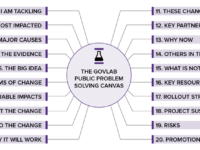
The GovLab's Public Problem Solving Canvas is an online interactive canvas based on twenty questions to create and develop your public interest project. These twenty questions are designed to help you refine your understanding of the problem and those whom it affects; express your Big Idea; and turn that idea into an actionable strategy in the real world to the end of improving people's lives.
The term data collaborative refers to a new form of collaboration, beyond the public-private partnership model, in which participants from different sectors — including private companies, research institutions, and government agencies — can exchange data to help solve public problems.
This resource outlines 8 Phases for designing and implementing a data collaborative (partnership) at an institutional level. The online resource includes examples, enablers, tools, and resources for…
The Design Process Mini-Guide is five-page document outlining a design process taught at the Stanford d.school. The school gives this resource to students after a short design experience, to help solidify the takeaways and abstract the experience to useful framework. The publishers suggest using the document in conjunction with an action-oriented design experience, such as their related Gift Giving Project and Wallet Project. This resource is on an older archive version of the d.school website.…
The Gift-Giving Project is 90-minute (plus debrief) fast-paced project though a full design cycle, intended to give learners a tangible experience with design thinking. It is intended as a group activity (from 2 to 100+ participants) with a facilitator.
Learners pair up to interview each other, come to a point-of-view of how they might design for their partner, ideate, and prototype a new solution to "redesign the gift-giving experience" for their partner. The resource includes a handout, a…
The Better Government Toolkit provides resources to build a better government through innovation. It focuses on four areas/verticals: Build a 21st Century Culture and Workforce, Improve Government Services Delivery, Solve Complex Problems, Collaborate with Innovators. It includes case studies within the United States Government. Each tool includes approach, actions and considerations, glossary of terms, related policies, and related resources.
This resource describes open government good practices and presents them to encourage further adoption and innovation. The publisher's goal is to help government reformers and civil society partners in improving the quality and output of co-creation processes across the Open Government Partnership (OGP). The resource was created to aid OGP partners but is applicable to others interested in open government.
The Toolkit contains content organised in a Question & Answer format, a matrix of…
This guidance contains 13 implementation plans laying out practical ways to address corruption. It is divided into 6 issue areas, each with an overview of the problem as well as solutions. The plans emerged from “Smarter Crowdsourcing Anti-Corruption” (2017). The Smarter Crowdsourcing method is an agile process, which begins with problem definition followed by online sourcing of global expertise to surface innovative ideas and then turns them into practical implementation plans. This…