
This is a knowledge base containing existing societal and public sector needs, emerging trends, methods, tools, technologies and applications. They are filterable by asset type, need, and type of trend.
Toolkit Features: Examples or Cases

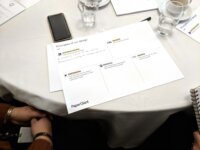
This is canvas and background guidance around a set of principles for co-design, inspired by the principles developed by the NSW Council of Social Services. The principles are: Outcomes-focused, Inclusive, Participative, Respectful, Adaptive.
The canvas includes an example case study.

This resource focuses on inclusive design, a methodology that enables and draws on the full range of human diversity, including those with limited abilities. The resource includes a guide on inclusive design, multiple short-films and a 20-minute documentary, as well as activity cards that follow 5 phases of a design process.
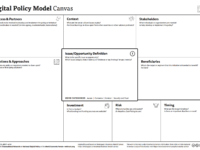
This canvas guides policy makers to derive specific policies and regulatory mechanisms in an agile and iterative manner – integrating both design thinking and evidence based policy making. An associated White Paper provides background on the approach.
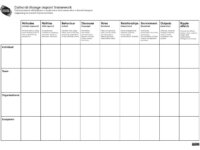
This resource includes a framework, basic guidance and canvas for use in mapping and assessing organisational readiness and capacity development, designing and developing assessment criteria for capacity-building, facilitating strategic dialogue, supporting and assessing the impact of innovation teams and labs, and enabling structured focus on what elements should be prioritised in capacity-building efforts as well as for case production and knowledge sharing.

The Better Government Toolkit provides resources to build a better government through innovation. It focuses on four areas/verticals: Build a 21st Century Culture and Workforce, Improve Government Services Delivery, Solve Complex Problems, Collaborate with Innovators. It includes case studies within the United States Government. Each tool includes approach, actions and considerations, glossary of terms, related policies, and related resources.
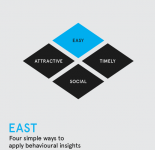
EAST is a framework and summary of the Behavioural Insights Team's knowledge of behavioural science, developed for busy policymakers. It is based around principles of making actions Easy, Attractive, Social and Timely (EAST) applied to a 4-step process: 1. Define the outcome, Understand the context, Build your intervention, and Test, learn, adapt.
It is a more simplified version of the publisher's prior MINDSPACE framework. The resource includes overall guidance and case studies.
The OGP Toolbox is a collaborative platform that gathers digital tools developed and used throughout the world by organizations to improve democracy and promote transparency, participation and collaboration.
It is designed as a social network and includes use cases and tool "collections," technical criteria informed by the community and recommendations based on the experience of users that have already implemented existing solutions.
The goals of the publisher and platform are to:
- allow actors…
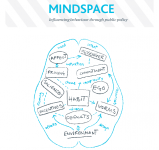
The MINDSPACE report is used by the Behavioural Insights Team as a framework to aid the application of behavioural science to the policymaking process. It is a predecessor of the more simplified EAST framework. It describes four actions that should underpin government‟s attempts to change behaviour: Enable, Encourage, Engage and Exemplify. It includes a users guide for understanding what affects human behavior and describes the MINDSPACE framework through several case studies.

Public Design Vault is a curated directory of 500+ design tools & resources for public good. These resources are intended for those working at the intersection of human-centered design, innovation and public/social impact. The resource also contains "collections," or bundles of tools each categorized according to a use case (e.g. brainstorming) or a specific topic (e.g. leadership).