User Type: Practitioner
The toolkit provides an approach and methods those looking for a new way to tackle social and policy issues by making services more valuable to customers and users, easier to use, with fewer resources wasted on implementing the right ideas in the wrong way (or on the wrong ideas entirely).
This approach involves spending time understanding people’s experiences and resources on their own terms, taking methodical steps to analyse and address these with their active participation, and pushing for…
The Shift Surrey guide provides an overview of Surrey's design approach to date, including a summary of projects and suggestions for building an internal community of practice inside government. At the end of the guide, there are several typical design tools, tips and tricks learned through Surrey's experience and suggestions for related design resources.
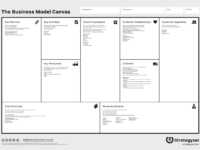
This canvas and associated guidance is is a strategic management and lean startup template that can be used the to describe, design, challenge, and pivot a business model to deliver different values or in different ways. It consists of 9 elements: value proposition, customer segments, customer relationships, channels, key partners, key resources, key activities, cost structure, and revenue streams.
It can be used individually or in a group. It works in conjunction with the Value Proposition…
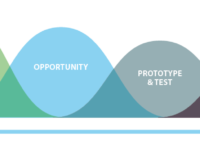
This resource describes a comprehensive method for the BC Public Service (BCPS) to design services for British Columbians, although it is also applicable to other governments.
The Playbook is intended to help ensure public service designers have the necessary tools and corporate support to make change.
It includes an overview of service design, a discussion of when and how to use it, as well as detailed guidance and tools for the various methods used in service design. The methods are organised…
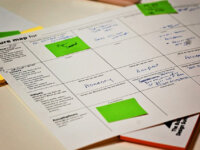
A tool that organizations can use to assess, map and transform their cultures. It is intended at a group activity to guide conversations around outcomes, behaviours, and enablers/blockers. The website also contains guidance for its use. It is intended for a private sector context but non-financial "outcomes" can also be considered when using it in the public sector.
This is a starter kit covering signal spotting, or detecting early signs of change in several fields: Technology, Policy, Business model, Citizen action, Research finding, Design, Application, Idea / innovation. The online resource includes video guidance, examples of signals in the different fields, and exercises for practice with signal spotting. It also includes exercises for signal spotting in one's own context.
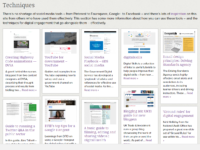
This web-based resource contains ideas and practical help to use digital and social media in the public sector. It is organised by techniwues, strategies, examples, and (user generated) questions. This resource can assist governments with service delivery and stakeholder engagement. The publisher's main website also contains other resources for online communication.
A guide intended for the Australian government for designing public services in user-centered and iterative ways. This resource is intended to help teams start small and learn fast, and to create services that can be delivered quickly and to save money by reducing service failure.
It is organised into 4 design and delivery stages, each with an associated guide: Discovery, Alpha, Beta, Live.
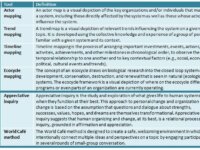
A blog series introducing and sharing guidance for using different tools to support systems thinking and practice, including actor mapping, trend mapping, timeline mapping, ecocycle mapping, appreciative inquiry, and world cafe. Each offers a downloadable guide in exchange for an email address.
The publisher defines Open Policy Making as developing and delivering policy in a fast-paced and increasingly networked and digital world through collaborative approaches, new analytical techniques, and testing and iteratively improving policy.
The manual includes information about Open Policy Making in the United Kingdom government as well as tools, step-by-step guidance and techniques policy makers can use to create more open and user led policy.