

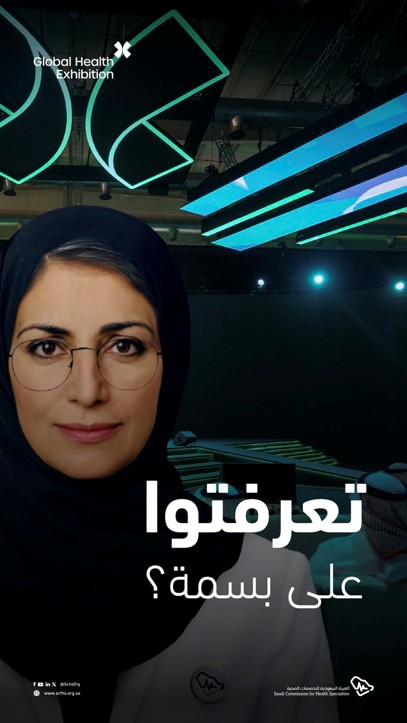
The Saudi Commission for Health Specialties introduced Basma as a new model to help healthcare professionals navigate complex regulatory services more easily. The platform uses artificial intelligence and a localized avatar to translate regulations into clear, step-by-step guidance, enabling practitioners to understand requirements and complete processes independently. This improves access to services, reduces confusion, and enhances the efficiency of regulatory service delivery.
Innovation Summary
Innovation Overview
As public sector systems become more complex, particularly in highly regulated domains such as healthcare workforce governance, professionals increasingly face challenges navigating fragmented services, interpreting policies, and translating regulatory knowledge into practical actions. This creates inefficiencies, delays, and a growing reliance on manual support channels.
It is in this context that the Saudi Commission for Health Specialties (SCFHS) introduced Basma as a new model for delivering regulatory services. Rather than functioning as a traditional digital platform, Basma represents an AI-enabled regulatory intelligence layer that transforms how users interact with public services. The initiative was initially introduced within the healthcare regulatory ecosystem and is now positioned as a scalable model for broader public sector application.
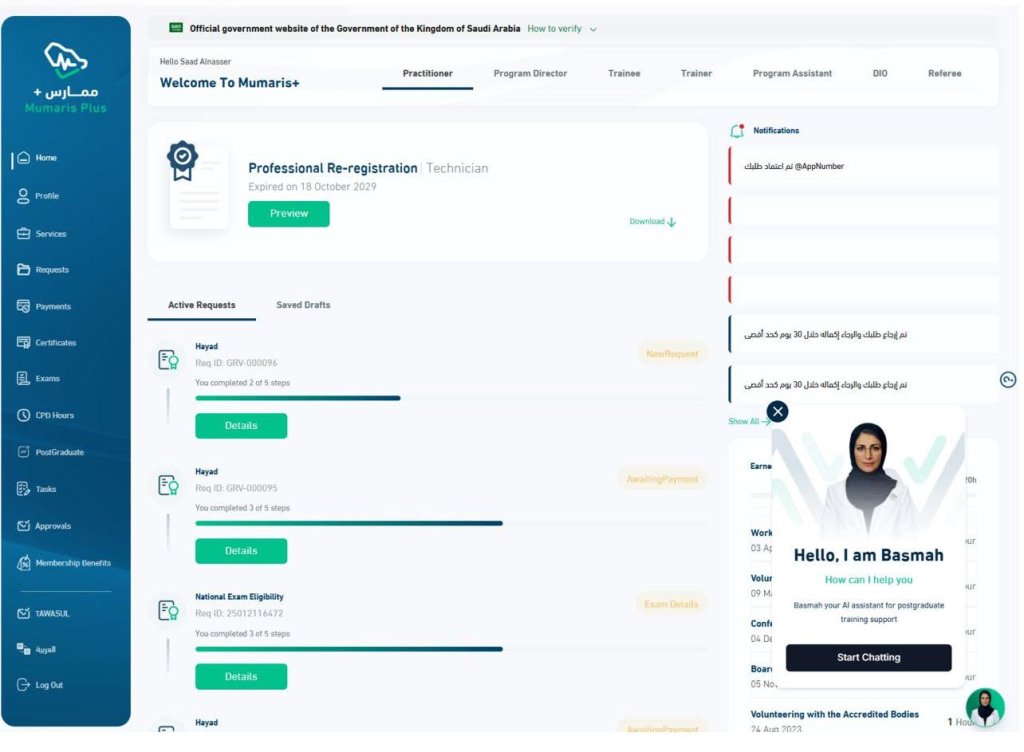
In this model, healthcare practitioners interact with regulatory systems through natural language, allowing them to receive clear, contextual, and step-by-step guidance tailored to their specific professional situation. Instead of navigating multiple systems or interpreting complex documentation, users are guided through processes such as licensing, training, and professional development using a unified digital interface.
The objectives of this model are three-fold:
1. Simplify access to regulatory services by converting complex policies into actionable guidance
2. Improve efficiency by reducing reliance on manual support channels and minimizing administrative delays
3. Strengthen governance by enhancing clarity, consistency, and accessibility of regulatory processes
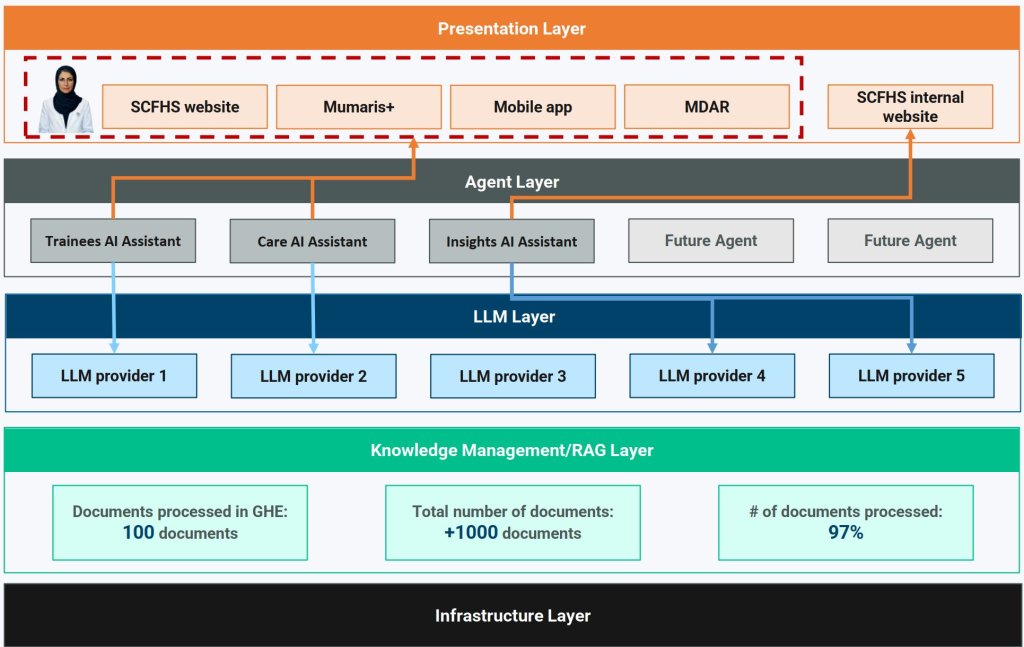
To enable this model, Basma integrates domain-specific artificial intelligence with structured regulatory knowledge and existing digital government platforms. It operates as an intelligent orchestration layer that connects users with multiple services while ensuring that all guidance is grounded in verified institutional policies.
By moving from static information delivery to dynamic, guided interactions, the model reduces ambiguity in decision-making and enables users to complete regulatory processes more efficiently and independently. It also supports institutions by reducing operational burden and improving service delivery outcomes.
Ultimately, Basma represents a shift from digitizing services to transforming how governments operationalize regulatory knowledge. The model demonstrates how artificial intelligence can be embedded within public sector systems to improve service accessibility, enhance decision-making, and enable scalable, user-centered governance.
Innovation Description
What Makes Your Project Innovative?
Basma is an innovation in public sector service delivery because it introduces a new model for translating regulatory knowledge into actionable guidance, providing users with clear, step-by-step support tailored to their specific situations instead of relying on static information portals. It embeds artificial intelligence as a core capability, enabling real-time interpretation of policies and reducing ambiguity in decision-making. It also functions as an intelligent orchestration layer, connecting fragmented government systems into a unified user experience through a single interface. Furthermore, it shifts digital government from static service delivery to dynamic, user-centered interactions, where accessibility, clarity, and efficiency are built into the service design rather than added as external support.
What is the current status of your innovation?
The innovation is currently in the implementation phase, actively deployed within the Saudi Commission for Health Specialties. Basma is used in real service interactions, enabling practitioners to navigate licensing and training through AI-driven guidance. It has moved beyond pilot to operational use, with continuous improvement. Ongoing evaluation enhances accuracy and usability, with plans to scale across public sector services.
Innovation Development
Collaborations & Partnerships
The innovation was developed through collaboration between SCFHS, technical teams, and healthcare practitioners. SCFHS defined regulatory requirements and enabled real-world deployment. Technical teams designed and implemented the AI architecture and system integration. Practitioners provided continuous feedback on usability and accuracy, ensuring the solution addresses real operational needs and aligns with healthcare regulatory processes.
Users, Stakeholders & Beneficiaries
Healthcare practitioners are the primary beneficiaries, gaining easier access to regulatory services and clearer guidance across licensing, training, and professional development processes. SCFHS benefits through improved service efficiency and reduced reliance on manual support channels. Secondary stakeholders include regulators and policymakers, who gain insights from user interactions to improve governance and workforce planning.
Innovation Reflections
Results, Outcomes & Impacts
The innovation improves how healthcare practitioners access and navigate regulatory services by providing clear, actionable guidance. It supports over 737,000 practitioners across 38 nationalities and contributes to more efficient interaction with over 42 digital services. Early results show reduced reliance on manual support channels and improved user experience, reflected in satisfaction rates exceeding 90%. Outcomes are assessed through service usage patterns, user feedback, and performance indicators such as response time and successful service completion, demonstrating improved accessibility, efficiency, and institutional service delivery.
Challenges and Failures
Key challenges included maintaining up-to-date regulatory knowledge in a rapidly evolving healthcare environment, ensuring consistent accuracy of AI-driven guidance, and building user trust and adoption. Additional challenges involved safeguarding data privacy and security, establishing scalable and reliable AI infrastructure to handle high user demand, and supporting a diverse, multinational healthcare workforce with varying needs. These challenges were addressed through continuous model refinement, integration of verified knowledge sources, strong data governance practices, scalable system architecture, and user-centric design to enhance reliability, accessibility, and trust.
Conditions for Success
The success of the innovation was enabled by strong institutional leadership and alignment with national digital transformation priorities. SCFHS provided a clear regulatory framework and access to real service environments, supporting practical implementation. Advanced AI infrastructure and domain-specific expertise enabled accurate and scalable system development. Continuous engagement with healthcare practitioners ensured user-centered design and relevance. Additionally, a supportive innovation culture allowed iterative development, experimentation, and integration within existing digital government systems.
Lessons Learned
A key lesson is that complex regulatory systems require more than digitization; they need intelligent interpretation layers that translate policies into actionable guidance. Continuous engagement with end users is essential to ensure relevance and usability. Another lesson is that AI in public services must be iteratively developed and validated in real operational environments to ensure reliability and trust. Finally, strong institutional alignment and integration within existing systems are critical to scaling innovation from a pilot into a sustainable governance model.
Anything Else?
Basma represents a shift from traditional digital services to an AI-enabled governance model where regulatory knowledge is actively interpreted and operationalized. The model is designed to be replicable across sectors that rely on complex regulatory frameworks, such as education, finance, and professional licensing. By functioning as a scalable intelligence layer integrated with existing systems, the innovation demonstrates how governments can enhance service delivery, improve regulatory clarity, and strengthen institutional efficiency through responsible use of artificial intelligence.
Project Pitch
Supporting Videos
Status:
- Implementation - making the innovation happen
Innovation provided by:

Media:


Files:
Date Published:
29 September 2026