

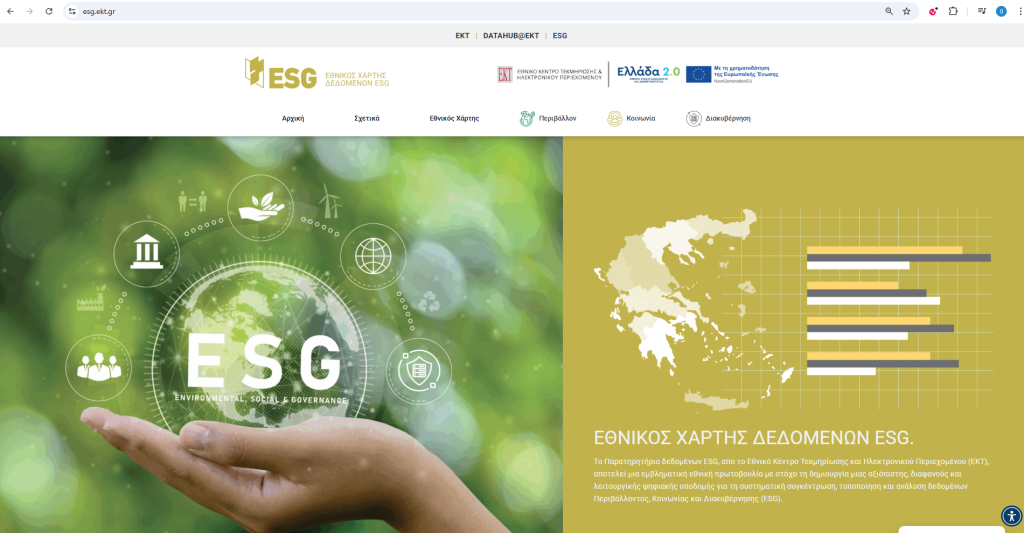
Homepage view of Greece’s National ESG Data Map, a public platform that standardises and visualises ESG indicators.
Greece lacked comparable Environmental, Social and Governance (ESG) data across firms. The National ESG Data Map (esg.ekt.gr) is a public digital platform that collects data from trusted sources, standardises them and publishes comparable ESG indicators and dashboards for businesses and policy makers. It supports targeted policy and green finance decisions and helps companies prepare for EU sustainability reporting.
Innovation Summary
Innovation Overview
In Greece, Environmental, Social and Governance (ESG) data are fragmented across sources, defined with different methodologies, and therefore difficult to compare. This limits evidence-based policy design, targeted incentives, and the ability of businesses and financial actors to benchmark performance. At the same time, EU sustainability reporting requirements are becoming more demanding, increasing the need for standardised, reliable data.
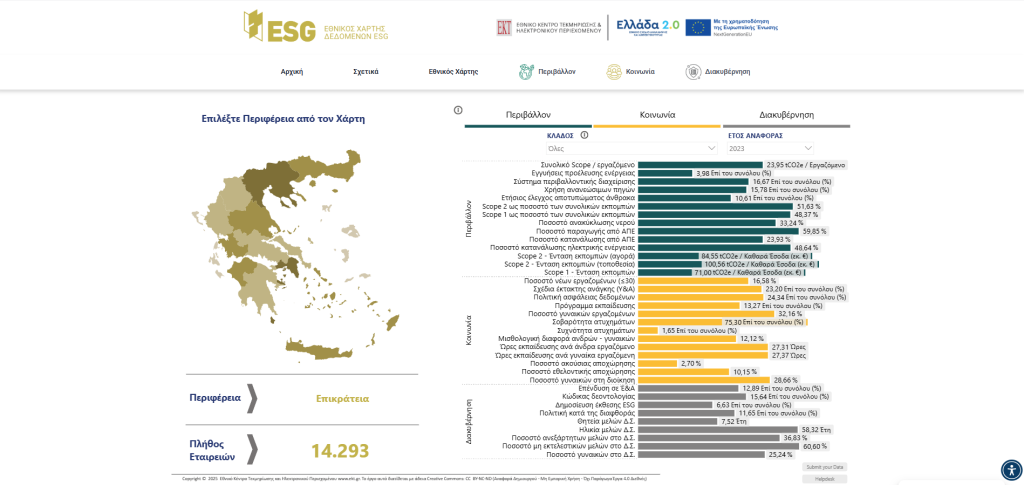
The National ESG Data Map (esg.ekt.gr) is a public digital data-governance infrastructure developed by the National Documentation Centre (EKT). It integrates ESG-related data from multiple institutional and publicly available sources, applies data quality rules (consistency, completeness, and traceability), and transforms heterogeneous inputs into comparable ESG indicators. Results are delivered through interactive dashboards and Business Intelligence (BI) reports that allow comparisons by sector and region.
The platform aims to (i) provide a shared “data language” for ESG in Greece, aligned with leading international standards such as the European Sustainability Reporting Standards under the EU Corporate Sustainability Reporting Directive (ESRS/CSRD), the Global Reporting Initiative (GRI) Standards and the Greenhouse Gas Protocol, (ii) enable benchmarking and transparency for businesses, (iii) support public authorities with evidence for policy design and monitoring (e.g., green finance, targeted tools and programmes), and (iv) reduce administrative burden by reusing common definitions and indicators. Beneficiaries include businesses, financial institutions, public authorities, and the research community, and—indirectly—the wider public through more transparent sustainability information.
The current version covers 14,293 companies across all 13 regions of Greece and 11 economic sectors, producing 38 ESG indicators, with scope to expand data sources, time-series coverage, and analytical features. The innovation is designed to be scalable and sustainable through continuous data integration, documented methodology, and an operational model for ongoing maintenance and updates.
Innovation Description
What Makes Your Project Innovative?
The innovation is a national mechanism for ESG data governance, not just a website. It brings together heterogeneous ESG data from multiple sources, applies documented quality and traceability rules, and converts them into comparable indicators and visualisations aligned with recognised standards (ESRS/CSRD, Global Reporting Initiative (GRI) Standards, Greenhouse Gas Protocol and International Organization for Standardization (ISO) standards). This addresses a complex and evolving challenge—data heterogeneity, different methodologies and a changing regulatory landscape—where no ready national solution existed. By creating a reusable indicator catalogue and a BI reporting layer, the platform reduces information costs and enables consistent benchmarking for policy and market actors.
What is the current status of your innovation?
The platform is in full operation and continues to evolve. EKT maintains the data integration pipeline, updates the indicator catalogue and dashboards, and works with data-providing institutions to expand coverage, add historical time series and refine quality checks and documentation.
Innovation Development
Collaborations & Partnerships
Public-sector partners and data providers include the Ministry of Environment and Energy, the Hellenic Development Bank and the Natural Environment and Climate Change Agency. Their datasets and domain expertise are essential for coverage and credibility. EKT leads the standards alignment, data governance, indicator design and the public dissemination platform.
Users, Stakeholders & Beneficiaries
Beneficiaries include businesses (benchmarking and readiness for reporting), financial institutions (risk and sustainability analysis), public authorities (evidence for policy design, monitoring and targeted tools), and researchers/analysts (access to structured indicators). The wider public benefits from more transparent sustainability information.
Innovation Reflections
Results, Outcomes & Impacts
The platform provides a single national and public reference point for comparable ESG indicators. It currently covers 14,293 companies across all 13 regions of Greece and 11 economic sectors, producing 38 ESG indicators and interactive BI dashboards. This improves access to reliable information for benchmarking, supports more targeted public interventions (e.g., green finance and sectoral programmes), and reduces information and administrative costs by using common definitions and reusable indicators. It also strengthens preparedness for EU sustainability reporting (CSRD/ESRS) by promoting standardised, traceable data.
Challenges and Failures
Key challenges included heterogeneous data formats and definitions across sources, uneven data completeness, and the need to ensure comparability while ESG standards and regulation continue to evolve. These were addressed through an indicator catalogue with clear definitions, documented transformation rules, iterative quality checks, and close coordination with data-providing institutions. A further challenge is sustaining regular updates; this is managed through an operational maintenance model and planned expansion of data pipelines.
Conditions for Success
Success depended on: (i) EKT’s mandate and leadership in data governance and evidence for policy, (ii) an interdisciplinary team (data engineering, ESG analytics, BI reporting and communication), (iii) strong collaboration with institutional data providers, (iv) alignment with recognised international standards and EU CSRD/ESRS requirements to ensure credibility and reuse, and (v) sustainable resourcing for operation and updates (pilot funding plus an ongoing maintenance model). Clear governance, transparent methodology, user feedback loops and a shared public-value motivation were also critical.
Lessons Learned
Start with a clear indicator catalogue and agreed definitions before building dashboards. Treat data quality and traceability as core design features, not afterthoughts. Align early with international standards to reduce future rework and to make data reusable for multiple purposes (policy, finance, reporting). Deliver iteratively: pilot with real data, test with users, then scale coverage and features. Finally, invest in partnerships with data owners—long-term value depends on sustained data flows.
Anything Else?
Supporting materials include a short slide deck and the indicator-to-standards alignment matrix (ESRS/CSRD, GRI, GHG Protocol, ISO, SASB and SDGs). The initiative was publicly presented as a national ESG data infrastructure at the Thessaloniki International Fair (TIF) communication event, helping to raise awareness among stakeholders and potential users.
Supporting Videos
Status:
- Implementation - making the innovation happen
Innovation provided by:

Media:
Files:
- National ESG Data Map (esg.ekt.gr) – Presentation Deck (TIF/DETH)
- National ESG Data Map – Indicator Metadata and Standards Alignment (English) This document provides the English version of the indicator metadata used in the National ESG Data Map (esg.ekt.gr). It lists the ESG indicators included in the platform, a short definition for each indicator, and the corresponding alignment to recognised international frameworks and standards (e.g., ESRS/CSRD, GRI, GHG Protocol, ISO, SASB, SDGs). The table supports transparency, comparability, and reuse of the indicators for benchmarking, policy analysis, and sustainability reporting readiness.
Date Published:
29 September 2026