

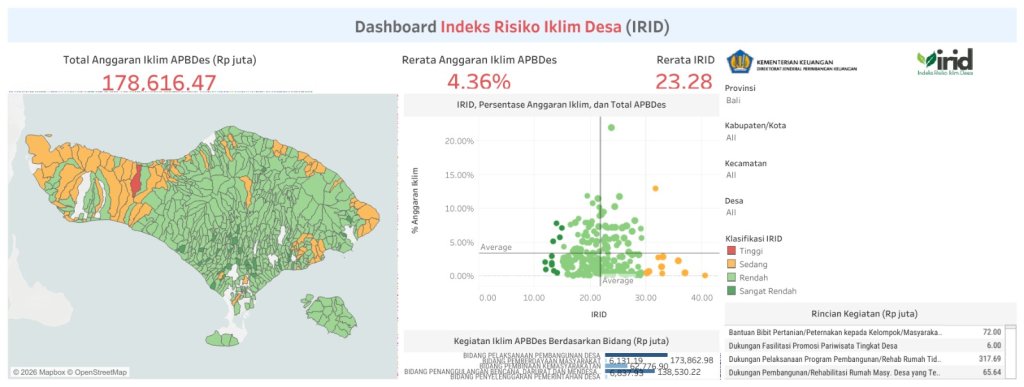
Indonesia ranks as world's second most disaster-prone country, with climate-related losses reaching Rp50 trillion (±USD 3 billion) annually. Over 75,000 villages bear the greatest burden of climate and disaster risks, yet often lack the data needed to allocate climate and disaster budgets effectively. IRID Dashboard, developed by the Ministry of Finance, integrates climate risk indices, village budgets, and fiscal transfers into one free, map-based platform. Users can filter and analyze data down to the village level, making it a practical decision-making tool rather than simply a data repository.
Innovation Summary
Innovation Overview
Indonesia ranks 2nd out of 193 countries in disaster risk, with 75% of disasters driven by climate change and annual economic losses reaching up to Rp50 trillion (approximately USD 3 billion). Despite this, most of Indonesia's 75,000+ villages lacked risk maps, early warning systems, or adequate action plans. Existing climate risk platforms — SIDIK (Sistem Informasi Data Indeks Kerentanan), developed by the Ministry of Environment, and InaRISK, developed by the National Disaster Management Agency (BNPB) — operated in silos and were disconnected from village budgeting systems, making it difficult to direct climate resilience spending effectively.
The IRID (Village Climate Risk Index) Dashboard is a free, publicly accessible map-based digital platform developed by the Directorate General of Fiscal Balance, Ministry of Finance. It assesses every village in Indonesia across four equally weighted dimensions — exposure, sensitivity, adaptive capacity, and hazard potential — and visualises how much of each village's budget from the Village Revenue and Expenditure Budget (Anggaran Pendapatan dan Belanja Desa) is allocated toward mitigation, adaptation, and preparedness activities. Its primary objective is to provide evidence-based data to support more responsive to climate risk fiscal policy and village development planning.
The dashboard benefits village governments when it comes to budget planning, regional governments for territorial development planning, the central government for fiscal policy design, non-governmental organisations for identifying priority programme locations, and the general public for accessing village-level climate risk information. What sets the IRID Dashboard apart from other platforms is its integration of climate risk data, village budgets, and fiscal transfer mechanisms into a single platform filterable down to the village level — making it an actionable policy instrument rather than just a data platform. Through the Affirmative Allocation (Alokasi Afirmasi), villages with high IRID scores receive additional Village Fund for adaptation activities, while the Performance Allocation (Alokasi Kinerja) incentivises villages to continuously improve their climate resilience. The Affirmative Allocation for high-IRID villages has been formally institutionalised under Minister of Finance Regulation (PMK) No. 7/2026.
Looking ahead, IRID will be integrated with national and regional geoportals — embedding its data layers into the planning platforms used by regional development and environmental agencies so that these agencies can access village-level climate risk data within their own workflows without requiring separate data requests. Further developments include AI-based recommendations that automatically generate village-specific climate action plans, and annual joint data updates by DJPK and the Ministry of Villages to keep the platform current and relevant.
Innovation Description
What Makes Your Project Innovative?
Prior to IRID, no platform linked climate risk assessment to village fiscal planning. Existing tools — SIDIK and InaRISK — produced risk data in isolation, unconnected to budget decisions, while Village Fund allocations within DJPK were determined without any consideration of climate vulnerability. As a result, the most at-risk villages failed to receive adequate targeted funding.
IRID addresses this by embedding a composite climate risk index directly into the national fiscal transfer formula. The IRID score is not a reporting output — it is an operational input that determines which villages receive Village Fund through the Affirmative Allocation. An auto-tagging feature currently under development will, for the first time, map village-level climate spending, converting previously undetected budget data into a concrete policy basis. For the first time in Indonesia, a village's climate risk level directly determines how public funds are allocated. This solution is backed by a formal regulation.
What is the current status of your innovation?
IRID was developed through a gap analysis of climate risk-based Village Fund targeting, designed via cross-agency collaboration, and field-validated in Toseho Village, Tidore Kepulauan (November 2024). Officially embedded in PMK No. 7/2026 and launched on 28 June 2025, ongoing evaluation with DJPK and the Ministry of Villages continues to refine the index. The dashboard model has been identified as replicable by other agencies measuring indices for local governments or villages.
Innovation Development
Collaborations & Partnerships
IRID was built through collaboration across nine institutions: DJPK/MoF (index calculation), BNPB (disaster data), BMKG (hydrometeorological hazards), KLH (climate indicators and NDC monitoring), BPS (Podes socio-economic data), BIG (spatial shapefiles), Kemendagri (village administrative data and SIPD), Kemendes PDT (Village Index, SID, Village SDGs — MoU signed June 2025), and Bappenas (MTEF and low-carbon roadmap).
Users, Stakeholders & Beneficiaries
Village governments use IRID to allocate climate and disaster budgets more effectively. Regional and central government agencies — including DJPK, Kemendes PDT, and Bappenas — leverage it for risk-based fiscal planning. Vulnerable village communities are the primary beneficiaries, receiving more equitable funding affirmation. Research institutions and civil society organisations use it for climate spending advocacy and village-level budget monitoring.
Innovation Reflections
Results, Outcomes & Impacts
IRID aims to reduce climate disaster losses and improve fiscal targeting for the most vulnerable villages. Scores have been calculated for all 75,000+ villages across Indonesia and are publicly accessible via an interactive dashboard, enabling village governments to identify their risk levels and plan climate-responsive spending more effectively. Villages with very high IRID scores receive additional Affirmative Allocation under PMK No. 7/2026. A Cooperation Agreement with Kemendes PDT for SID–IRID data integration was signed in June 2025. Field validation in Toseho Village, Tidore Kepulauan (November 2024) confirmed index accuracy by comparing scores against local disaster records and community conditions.
Challenges and Failures
Key challenges include: harmonising data across agencies (BIG, BPS, BMKG, BNPB) with differing formats and update cycles; active cross-ministerial coordination; limited dashboard adoption at village and regional levels; and ensuring IRID remains permanently embedded in Village Fund allocation mechanisms. Solutions applied include: a formal cooperation agreement (MoU) between DJPK and Kemendes PDT for sustained data sharing; interoperability development through IRID integration with the Regional Financial Information System (SIKD); post-PMK socialisation to regional governments and village officials; and regulatory anchoring through IRID's institutionalisation in PMK No. 7/2026.
Conditions for Success
IRID's success rests on four mutually reinforcing factors. First, ministerial-level commitment, reflected in the Kemenkeu–Kemendes PDT MoU and the issuance of PMK No. 7/2026. Second, the existing Village Fund regulatory framework, which provided a structured channel to embed IRID into the national fiscal system. Third, a DJPK technical team uniquely combining fiscal policy expertise, spatial data analysis, and system development within a single unit. Fourth, formal data-sharing agreements with BIG, BPS, BMKG, BNPB, and Kemendagri — established before development began. Long-term sustainability is secured through dedicated platform maintenance budgets and regular team capacity building.
Lessons Learned
First, embedding a new measurement tool directly into an existing fiscal transfer formula is far more effective than creating a stand-alone programme — uptake becomes automatic. Second, cross-ministry data integration requires formal legal instruments agreed at leadership level before technical work begins. Third, a composite index must be designed transparently so that local governments can understand their own scores, building trust and ownership. Fourth, field validation is irreplaceable — desktop analysis alone cannot capture real-world vulnerabilities on the ground.
Anything Else?
IRID directly addresses all three 2026 OECD innovation themes. It simplifies government by consolidating fragmented climate risk data into a single operational dashboard. It strengthens the citizen-government relationship by giving village governments transparent, evidence-based tools to participate meaningfully in climate adaptation planning. It advances the measurement of efficiency and effectiveness by creating a quantifiable, annually updated link between fiscal transfers and village-level climate outcomes. Indonesia's annual direct economic losses from disasters reach Rp20–50 trillion, as reported by the Fiscal Policy Agency (BKF), Ministry of Finance, with 1 in 10 citizens at risk of disaster-driven poverty.
Status:
- Implementation - making the innovation happen
- Evaluation - understanding whether the innovative initiative has delivered what was needed
- Diffusing Lessons - using what was learnt to inform other projects and understanding how the innovation can be applied in other ways
Innovation provided by:

Media:
Date Published:
29 September 2026