
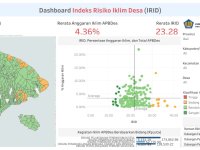
Indonesia ranks as world's second most disaster-prone country, with climate-related losses reaching Rp50 trillion (±USD 3 billion) annually. Over 75,000 villages bear the greatest burden of climate and disaster risks, yet often lack the data needed to allocate climate and disaster budgets effectively. IRID Dashboard, developed by the Ministry of Finance, integrates climate risk indices, village budgets, and fiscal transfers into one free, map-based platform. Users can filter and analyze data…
Innovation Tag: Open Government

New Brunswick faces an urban development challenge driven by record population growth, which also impacts biodiversity flow on the outskirts of urban regions. This Project used advanced virtual simulation technology to help municipalities evaluate urban development and infrastructure solutions before implementation. By creating digital replicas of cities and rural land use, decision-makers can test hundreds of scenarios and make evidence-based choices that improve territory management.
“Madrid, Digital Capital” is a city-wide transformation model that redesigns how Madrid delivers services and makes decisions using real-time data and digital tools. It simplifies procedures, improves daily services and helps the city respond faster to citizens and businesses. It is innovative because it turns digital transformation into a single, measurable system for running government, not just isolated projects, and that is fully user and citizen centred and also environmental centred.

Many rural communities face difficulties accessing government services due to distance, ageing populations and digital barriers. Navarra created Mobile Citizen Offices: travelling public service units that bring administrative procedures and digital support directly to small municipalities. By reversing the traditional model—government travelling to citizens—the initiative reduces territorial inequalities, simplifies access to administration and strengthens trust in public institutions.
Government digital systems can create invisible barriers for civil servants and citizens. Experiência.Gov is an evidence-based UX methodology created by public servants at Brazil’s Ministry of Management and Innovation in Public Services to identify and eliminate these frictions. The approach combines behavioral science, observation of real use, and agile prototyping to turn usage evidence into concrete improvements in government digital systems.
A digital platform that provides strategic and prospective quantitative and qualitative information, specifically on trends, risks, opportunities, scenarios, future events, and other topics. It is designed for use, consultation, and input by planners and the general public. It seeks to reduce the information gap, ensuring the validity and up-to-date nature of data for the formulation of plans and policies, thus facilitating the anticipation of challenges and the exploitation of opportunities.
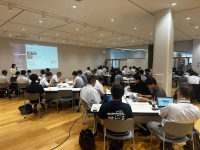
Digital Transformation Co-Creation Platform enables national and local governments to co-create policies and services through knowledge sharing and mutual learning. In Japan, diverse knowledge and challenges exist across about 1,780 local governments but are not adequately shared due to hierarchical communication structures. Digital Agency has developed a co-creation ecosystem where government officers nationwide can engage in open, flat, and two-way communications as individuals.
vCity is a human-centric platform for urban digital twins, with the goal of improving life quality within the city by assisting urban planners make evidence-driven urban decisions. vCity's innovative approach combines 1) simulation by designing virtual replicas of the cities, 2) what-if scenario tools in urban planning and 3) getting the "pulse" of the city from digital platforms for citizen participation.
The Government of Canada is experimenting writing existing laws and proposed regulations into code. Encoding rules allows us to run legal simulations in the regulatory drafting room, which helps us detect ambiguities, loopholes, and gaps in the rules that often go unnoticed. However, existing tools designed by and for programmers are not intuitive for rule-makers. In response, we set out to develop one – an open-source Rules as Code tool called Blawx.
India has several small cities lacking resources which has prevented them from offering digital services. To reduce the digital divide amongst the towns and cities and to ensure availability of digital services across the urban landscape of the country, NUDM attempts to offer a free, ready-made, and open-source software platform to cities and/or collectives (states). This platform is a choice-based model that benefits cities of varied maturity levels and preserves their existing investments.