
Government digital systems can create invisible barriers for civil servants and citizens. Experiência.Gov is an evidence-based UX methodology created by public servants at Brazil’s Ministry of Management and Innovation in Public Services to identify and eliminate these frictions. The approach combines behavioral science, observation of real use, and agile prototyping to turn usage evidence into concrete improvements in government digital systems.
Innovation Tag: Experimentation
Case Study
Humble Governance Journey: From Risk Aversion to Building Adaptive Leadership Capacity in…

Latvia's public administration struggles with complex challenges due to siloed operations and a deep fear of failure. Rather than structural reforms alone, Latvia is pioneering cultural shift through Humble Governance framework by Demos Helsinki with Prof. Charles Sabel (Columbia Law School) prioritising trust, shared responsibility, and courage under uncertainty. Cross-ministerial teams tackle real challenges through experimentation, shifting from a zero-mistake culture to iterative learning.
Governments often struggle to decide which emerging technologies are worth adopting and how to apply them responsibly. The Future Technology Observatory helps government entities identify, assess, and test high-potential technologies before adoption. It is innovative because it connects technology foresight with practical experimentation and adoption guidance in one shared government capability.
Public administration runs hundreds of projects and processes, but most public events still focus only on success stories. Spodlet za zalet creates a safe space where public servants openly share mistakes, wrong assumptions and unexpected turns, and reflect on what they learned. Inspired by Fuckup Nights, it turns failure into a practical source of learning and trust which encourages public sector innovation.
Case Study
FCINCO Anti-Sludge: a systematic method to identify and remove behavioural barriers in digital…
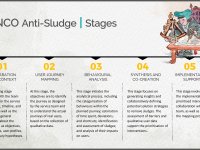
Digital public services often fail not only due to lack of provision, but because of invisible barriers that hinder or even prevent citizens from accessing and interacting with government in digital environments.
The FCINCO Anti-Sludge method systematically identifies and removes these barriers. Applied in real services, it can improve access, reduce friction, and increase the efficiency of public service delivery.

Despite ambitious climate pledges, a persistent “last-mile” gap remains: individual climate actions are often undervalued within existing frameworks. Gyeonggi Province addresses this gap by converting verified citizen actions into measurable public value and rewarding participants with local currency to support local economies. By reinvesting these rewards in climate technologies, the initiative transforms citizens from policy beneficiaries into active co-creators of a sustainable future.
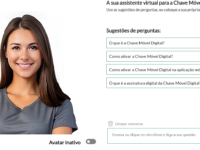
The Virtual Assistant project targets every person that may come to require information on how to access and make use of Portuguese Public Services. It takes the shape of an AI driven ChatBot (powered by ChatGPT3.5), designed on Azure Cloud AI architecture as a public/private partnership. Our Innovation demonstrates a clear use case for AI within the public sector, and it was developed to address effectiveness, efficacy and quality issues inherent to the provision of public services.
In order to continuously improve public policies and correct any deployment difficulties, the French Government has set up a data-driven steering system that allows it to monitor the results of more than 60 priority policies across all departments in its territory. This system is embodied by an internal steering and monitoring tool (PILOTE) and a citizen information site presenting the results in open data.
The Government of Canada is experimenting writing existing laws and proposed regulations into code. Encoding rules allows us to run legal simulations in the regulatory drafting room, which helps us detect ambiguities, loopholes, and gaps in the rules that often go unnoticed. However, existing tools designed by and for programmers are not intuitive for rule-makers. In response, we set out to develop one – an open-source Rules as Code tool called Blawx.
AllergyPAL is a dynamic, first of its kind, free training tool which has been designed for SME’s; particularly those operating in hospitality and retail. The concept of creating a novel delivery method assisting business customers improve their understanding of Precautionary Allergen Labelling (PAL) was developed after identifying a key gap in sector standards. AllergyPAL provides users with immersive training through a combination of Point of View (POV) technology and gamification.