Skip to content
An official website of the OECD. Find out more
Created by the Public Governance Directorate

This website was created by the OECD Observatory of Public Sector Innovation (OPSI), part of the OECD Public Governance Directorate (GOV).

How to validate authenticity

Validation that this is an official OECD website can be found on the Innovative Government page of the corporate OECD website.

Toolkit

EAST: Four Simple Ways to Apply Behavioural Insights

Basic BASIC:
Allows reuse
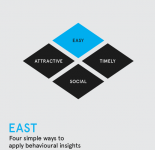
EAST is a framework and summary of the Behavioural Insights Team's knowledge of behavioural science, developed for busy policymakers. It is based around principles of making actions Easy, Attractive, Social and Timely (EAST) applied to a 4-step process: 1. Define the outcome, Understand the context, Build your intervention, and Test, learn, adapt. It is a more simplified version of the publisher's prior MINDSPACE framework. The resource includes overall guidance and case studies.
Toolkit

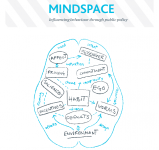
MINDSPACE

The MINDSPACE report is used by the Behavioural Insights Team as a framework to aid the application of behavioural science to the policymaking process. It is a predecessor of the more simplified EAST framework. It describes four actions that should underpin government‟s attempts to change behaviour: Enable, Encourage, Engage and Exemplify. It includes a users guide for understanding what affects human behavior and describes the MINDSPACE framework through several case studies.
Toolkit

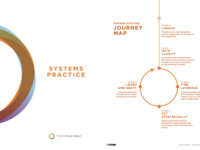
Systems Practice Workbook

Champion CHAMPION:
Can be remixed
This resource walks you through a systems practice, and describes process phases (Launch, Gain Clarity, Find Leverage, Act Strategically, and Learn and Adapt) and methods for guiding the practice. This resource has been developed in collaboration with teams across The Omidyar Group. This workbook aims to fill the gap between the promise of a systems approach for making social change and putting it into practice. It was created alongside curriculum as part of a paid course. For each method,…
The toolkit addresses the many complexities of devising and advancing digital skills at policy level. It maps out how digital skills take their place within a wider framework of soft, twenty-first century skills. It offers guidance on bringing together – and leading – different stakeholders and moving forward under one clear and focused framework.
Toolkit

OGP’s Participation and Co-creation Toolkit: From usual suspects to business as usual

Champion CHAMPION:
Can be remixed
This resource describes open government good practices and presents them to encourage further adoption and innovation. The publisher's goal is to help government reformers and civil society partners in improving the quality and output of co-creation processes across the Open Government Partnership (OGP). The resource was created to aid OGP partners but is applicable to others interested in open government. The Toolkit contains content organised in a Question & Answer format, a matrix of…
Toolkit

Designing for Behaviour Change Toolkit

Basic BASIC:
Allows reuse
This toolkit outlines Bridgeable’s approach to harnessing behavioural economics (BE) to design better products and services that nudge user behaviour. It combines a service design approach with a BE approach, with the caveat that BE helps identify and tweak pivotal moments of decision making but not overall user experience or strategies. The toolkit includes an overview of BE as well as an ideation and testing framework incorporating BE principles to move from a current state to an idea future…
Toolkit

Systems Mythology Toolkit

Champion CHAMPION:
Can be remixed
This toolkit was developed to help us cope with the rapidly changing world, such as global networks and autonomous drone fleets—that have never existed before. The publishers suggest that we need new stories and new mythologies to tell us how these things fit into our lives and make sense of these transformations. The toolkit contains a card deck exploring different colored "archetypes" or ways of making meaning and each includes different ways of understanding Interactions, Environments,…
Toolkit

UNDP Foresight Manual

This manual introduces strategic foresight as a practice in the context of the 2030 Agenda for Sustainable Development. It was created with consideration for the resource constraints in developing country contexts, so proposes light-touch and low-cost methods. However, it could easily be applied elsewhere. The manual features a selection of methods and techniques suited for framing development or policy discussions, but there are many methods and techniques available that are considered part of…
Toolkit

This is Service Design Doing – Method Library

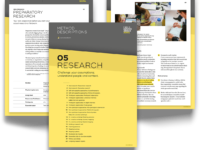
This resource is a method library containing 54 method descriptions for using the key methods in service design. These methods include instructions, guidelines, and-tips-and tricks for activities within research, ideation, prototyping, and facilitation. This collection only contains building blocks. It doesn’t detail how to assemble them into a cohesive design process or how to plan or manage it. The associated (paid) book and curriculum offers this context.
Toolkit

The Brains, Behavior & Design Toolkit

The toolkit is designed to be both informative and actionable - helping integrate the latest research in human behavior and decision making into practice. The toolkit features five tools to help designers apply findings from the field of behavioral economics to their practice in order to provide a head start on framing research as well as developing new strategies for solving user problems. The toolkit includes: Reference Cards: behavioral economics research findings organized and…