

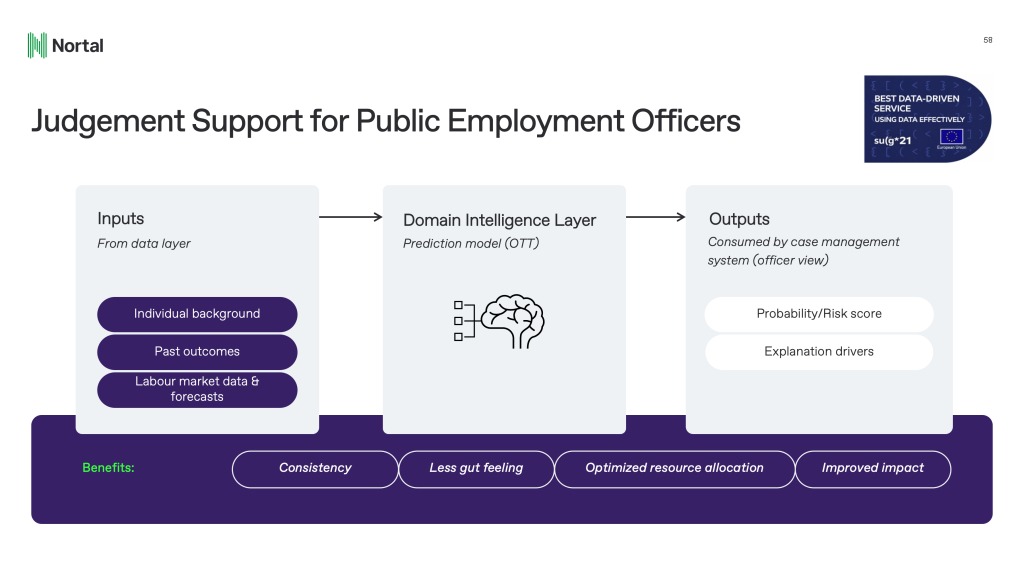
OTT2 helps Estonia’s Unemployment Insurance Fund identify which jobseekers are most at risk of long-term unemployment. It combines data from public registries and updates each person’s employment outlook as their situation changes, helping counsellors provide more timely and tailored support. This is innovative because it replaces a labour-intensive and inconsistent manual process with a dynamic, explainable and highly accurate system that improves how public resources are used.
Innovation Summary
Innovation Overview
Public employment services must make difficult decisions about how to allocate limited support among jobseekers with different needs. In Estonia, this assessment previously relied on counsellor judgement and a manual profiling process using around 45 indicators, including socio-demographic information, work history, labour market conditions, health status and vacancies. In practice, this was time-consuming, difficult to apply consistently and not well suited to quickly changing client circumstances.
To address this, the Estonian Unemployment Insurance Fund (EUIF) introduced OTT1 in 2020: a machine-learning-based decision-support tool that assessed a jobseeker’s employment prospects at registration. Over five years of operational use, EUIF built experience, trust and evidence on how data-driven profiling could support frontline decision making.
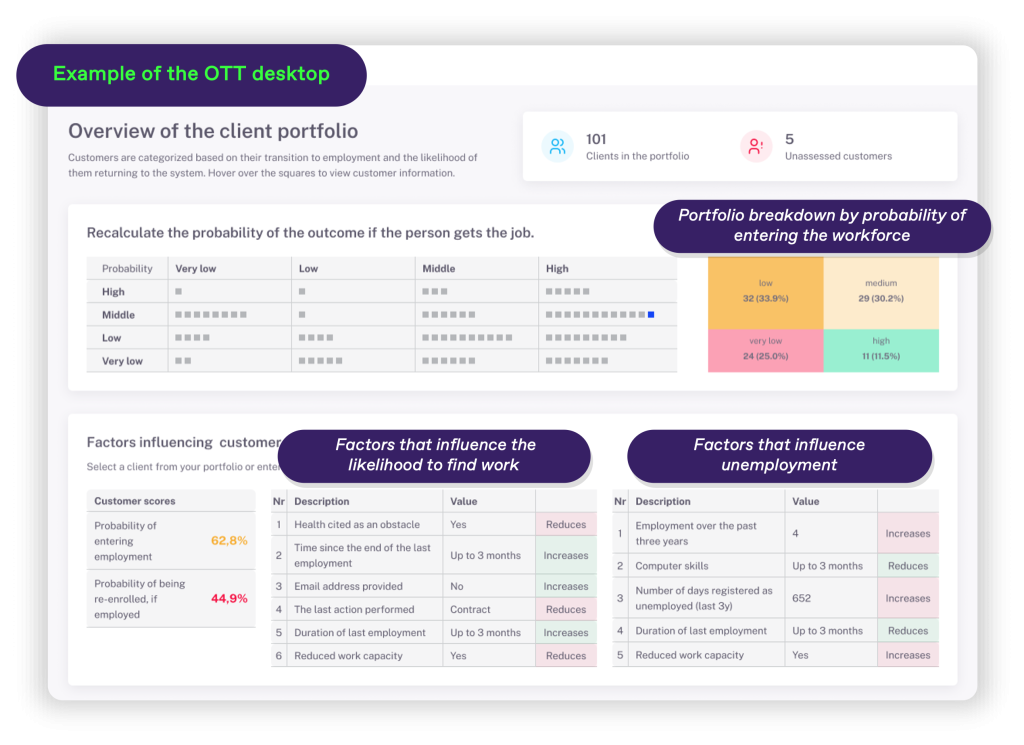
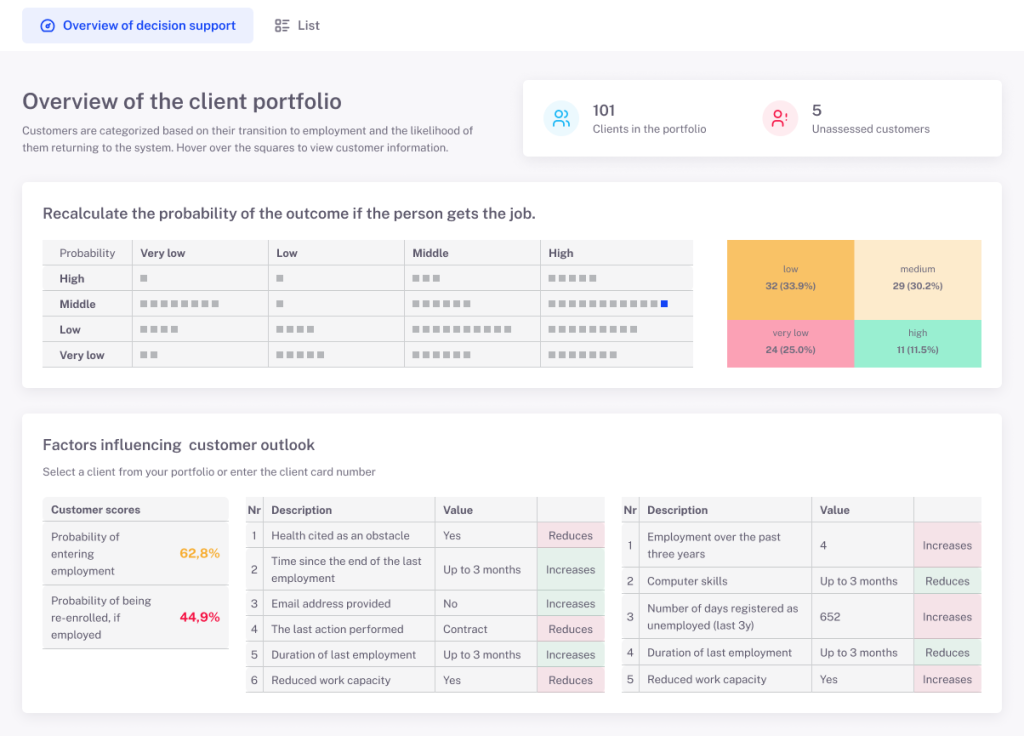
OTT2, introduced in 2026, is the next stage of that innovation. It makes the assessment dynamic by updating predictions when a jobseeker’s situation changes, for example after completing training or missing a service. It also shows the main factors shaping the result, helping counsellors understand and use the tool responsibly.
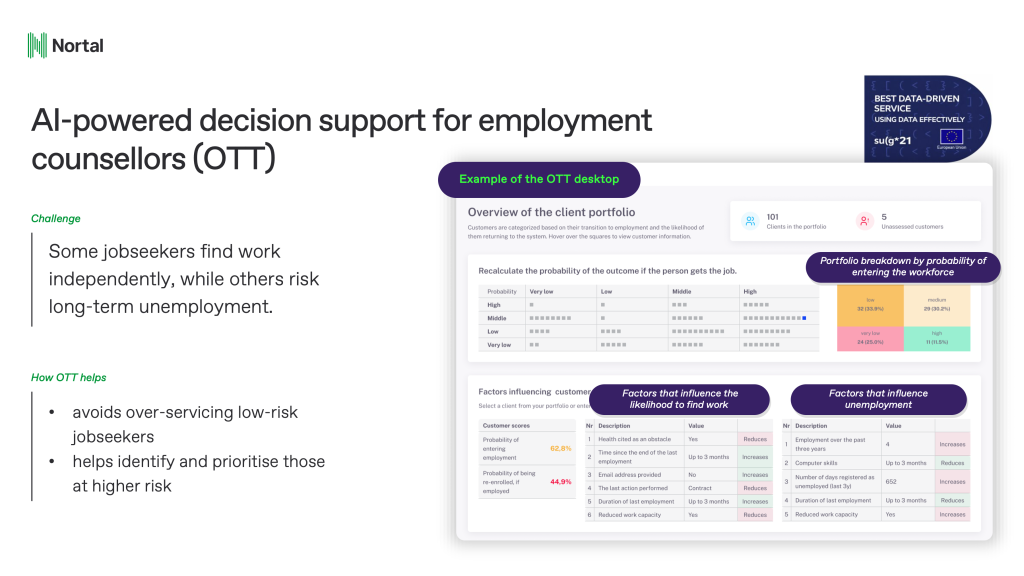
The innovation improves how employment services are delivered. It helps counsellors pay special attention to people who are most at risk of long-term unemployment, while reducing manual administrative work and increasing consistency in decision making.
In practice, this means counsellors no longer need to manually assess dozens of indicators at registration. Instead, they can focus on discussing next steps with the jobseeker, using the system’s assessment to prioritise support. When a client’s situation changes, the assessment is updated automatically, allowing support to be adjusted without restarting the process.
EUIF is now using OTT2 to support a 2026 pilot in which jobseekers with the strongest employment prospects may no longer require mandatory counselling, allowing staff capacity to be redirected to those with greater need. In future, the approach could be further institutionalized through routine service design, continuous evaluation and adaptation to other public services, where timely, targeted support matters.
Innovation Description
What Makes Your Project Innovative?
OTT2 is innovative because it moves employment assessment from a one-time, manual and largely judgement-based exercise to a dynamic, explainable decision-support system embedded in frontline public services. Unlike traditional segmentation tools, it combines linked administrative data from multiple public registries to update assessments as a jobseeker’s circumstances change and shows the main factors behind each indicator, helping counsellors understand and use the assessment responsibly.
Most public sector AI deployments are additive — a chatbot answering FAQs, a document summarizer or a search assistant. They sit alongside existing processes without changing them. OTT2 is different: it is embedded in the operational core and is the key enabler of a service reform that redirects counselling capacity away from lower-risk jobseekers and towards those at higher risk of long-term unemployment who need more intensive support.
What is the current status of your innovation?
OTT2 was put into practice in 2026 and is now being used within the Estonian Unemployment Insurance Fund as part of frontline employment service delivery. In 2026, it is supporting a pilot to test whether mandatory counselling can be fully removed for low-risk jobseekers so capacity could be fully focused on higher-risk groups. At the same time, its performance and operational effects are being monitored to inform future scaling.
Innovation Development
Collaborations & Partnerships
OTT was developed through close collaboration between the Estonian Unemployment Insurance Fund, the University of Tartu and Nortal. EUIF defined the policy problem, operational context and service needs; the University of Tartu contributed research and methodological expertise; and Nortal supported use-case definition, data science, technical delivery and service design. This interdisciplinary partnership was important for turning an analytical model into a usable public service tool.
Users, Stakeholders & Beneficiaries
The main beneficiaries are jobseekers, who can receive more timely and better targeted support. Frontline counsellors benefit from less manual profiling and clearer, data-informed guidance for decisions. EUIF managers benefit from a more consistent and measurable basis for allocating staff resources and evaluating service effectiveness. The wider public benefits if faster returns to work reduce welfare and unemployment-related costs.
Innovation Reflections
Results, Outcomes & Impacts
OTT2 builds on five years of operational experience with OTT1, which achieved over 95% prediction accuracy and established the value of data-driven decision support in employment services. OTT2 is designed to improve this further by updating assessments when a jobseeker’s circumstances change, with accuracy expected to exceed 98%.
Its impact is being tested through a 2026 pilot in which around 20% of newly registered jobseekers assessed as low risk may no longer require mandatory counselling. This is intended to free counsellor capacity for clients at higher risk of long-term unemployment. Results are being measured through model performance, operational monitoring and evaluation of service allocation effects.
Challenges and Failures
Deploying AI in a public service context created both technical and organizational challenges. An early lesson demonstrated that when counsellors were not sufficiently involved, trust and usability issues became harder to resolve after launch. Adoption also varied across staff groups.
EUIF responded by investing in seminars, webinars, guidance materials and support to embed the tool in everyday work. For OTT2, users were involved from the outset through interviews and feedback loops, improving relevance and usability.
The main lesson is that early user involvement is critical: building trust and usability from the start is more effective than addressing them later. EUIF now treats this as a standard condition for similar AI-enabled services.
Conditions for Success
Several conditions enabled this innovation to succeed: access to high-quality linked administrative data, strong institutional leadership from EUIF and close collaboration between policy, service design, data science and academic partners. Just as important was a phased approach: OTT1 created evidence, trust and operational learning before OTT2 introduced dynamic updates and a policy pilot. Clear human oversight, model retraining rules and explainability features were essential in a high-stakes public service environment, helping counsellors use the tool with confidence rather than treating it as a black box.
Lessons Learned
Three lessons stand out. First, adoption matters as much as model performance: involving frontline staff early improves usability, trust and uptake. Second, decision-support tools should be explainable and governed by clear human oversight, especially in high-stakes public services. Third, the process should be started with a practical use case and be built in stages. EUIF did not move directly to service redesign; it first tested, learned and built confidence through OTT1 before using OTT2 to support a policy pilot. Innovation was successful not because of AI alone, but because it was tied to a real operational problem and implemented iteratively.
Anything Else?
OTT2 is part of a broader effort to redesign employment services around evidence, proportionality and better use of public resources. It shows how government can introduce AI responsibly, with human oversight, measurable objectives and a clear link to service improvement.
This enables a shift from a standardized service model to a more needs-based approach, improving both efficiency and fairness. Counsellors can focus their time on those who need support most, rather than routine processes.
The approach may be relevant to other public employment services and agencies seeking to move from static assessments to more adaptive and targeted support.
Status:
- Implementation - making the innovation happen
Innovation provided by:

Media:
Date Published:
25 September 2026