

Digital public services often fail not only due to lack of provision, but because of invisible barriers that hinder or even prevent citizens from accessing and interacting with government in digital environments.
The FCINCO Anti-Sludge method systematically identifies and removes these barriers. Applied in real services, it can improve access, reduce friction, and increase the efficiency of public service delivery.
Innovation Summary
Innovation Overview
Governments around the world have invested heavily in digitalisation to modernise public administration, achieving significant advances in the reach and speed of public service delivery. In Brazil, this progress is exemplified by the GOV.BR portal, which centralises more than 5,000 federal public services and approximately 12,000 services when including state and municipal levels.
Despite these advances, persistent frictions still hinder access to and use of digital public services. These challenges are particularly relevant for more vulnerable groups, such as individuals with lower levels of education or older populations, who may face greater difficulty and insecurity in digital environments. Beyond infrastructure-related constraints, these frictions are often driven by behavioural barriers—commonly referred to as sludge—that make processes unnecessarily complex, confusing, or discouraging.
FCINCO Anti-Sludge is a systematic method designed to make these barriers visible, categorise them, and address them in digital public services. The approach combines behavioural insights with user journey analysis, interviews, and co-creation with service teams, enabling the identification of friction points and the development of practical, testable interventions.
The method has been iteratively refined through prototyping and application in real public services. It was recently applied to the Contrata+Brasil platform, which aims to increase the participation of microentrepreneurs in public procurement. The application, conducted across two user journeys (microentrepreneurs and public officials), identified critical barriers in registration and service use, generating feasible and targeted recommendations for improvement.
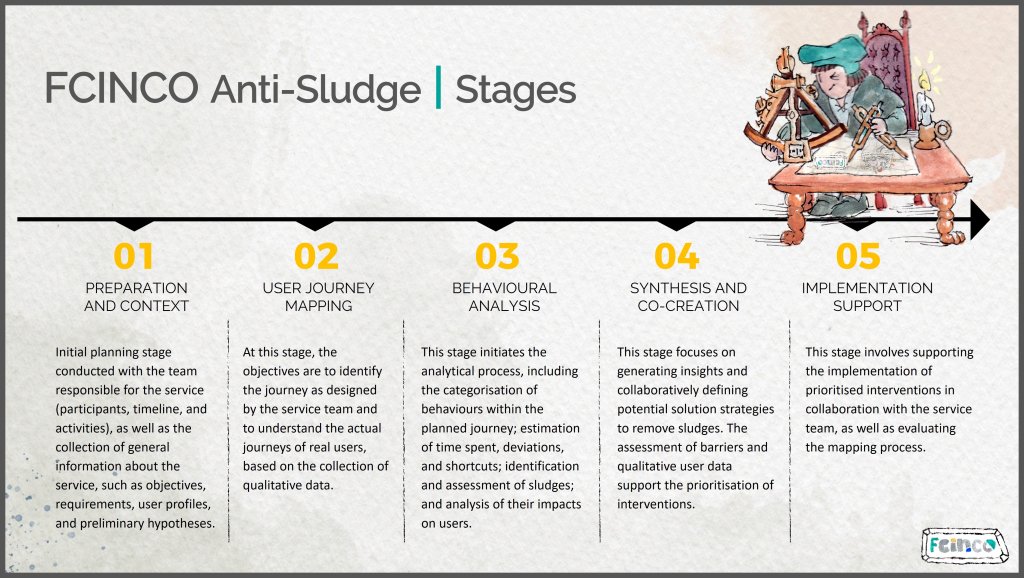
FCINCO Anti-Sludge aims to improve the efficiency of public services, enhance user experience, and expand access to rights and opportunities. Its five-step design enables replication across different contexts and levels of depth, supporting the simplification of government processes and strengthening the capacity of the State to interact effectively with citizens, while providing a scalable approach for improving service delivery across government.
Innovation Description
What Makes Your Project Innovative?
FCINCO Anti-Sludge is innovative because it transforms an often-invisible problem - behavioural barriers in digital public services - into a structured and actionable object of analysis. Unlike traditional service improvement approaches, the method applies behavioural insights to identify friction points that are not captured by standard technical or process reviews, nor by purely statistical access data.
The innovation also lies in its systematic and replicable design. The method provides a clear framework that can be applied by government teams to diagnose barriers and generate targeted improvements. By bridging behavioural science and practical service delivery, it enables scalable and consistent application across different contexts.
The method was developed and applied by a specialised behavioural insights unit within government, ensuring both technical robustness and practical applicability in real service settings.
What is the current status of your innovation?
The FCINCO method has already been implemented in the Contrata+Brasil platform, where it was applied to identify behavioural barriers and generate actionable improvements across the user journey, from the perspectives of microentrepreneurs and public officials, reflecting both sides of the programme. It is currently being refined based on practical application, with ongoing efforts to support its replication across additional public services.
Innovation Development
Collaborations & Partnerships
The innovation was developed within the Innovation Directorate by a specialised behavioural insights unit (CINCO), in collaboration with public officials responsible for the Contrata+Brasil service. The unit led the methodological design and application, while the service team contributed operational knowledge and co-created solutions. Users’ perspectives were incorporated through user observation, interviews, and user journey analysis.
Users, Stakeholders & Beneficiaries
In the application of the FCINCO method in the Contrata+Brasil programme, the main beneficiaries are microentrepreneurs and public officials using the platform to contract small services and repairs, who benefit from reduced friction and improved usability. More broadly, citizens benefit from more accessible digital public services, while public managers and service teams gain a structured and replicable method to identify and address behavioural barriers.
Innovation Reflections
Results, Outcomes & Impacts
The application of the method enabled the systematic identification of behavioural barriers across two user journeys, revealing critical friction points such as mismatches between expected and actual user behaviour, excessive choice categories, misalignment between page design and users’ mental models, poor information hierarchy, and limited support. These issues significantly affected usability and completion.
The method was applied in a service targeting a subset of microentrepreneurs in Brazil, within a broader ecosystem of over 16 million registered entrepreneurs. As digital public services are accessed through GOV.BR, with over 150 million users, the approach shows strong potential for large-scale impact. Evaluation is ongoing.
Challenges and Failures
One of the main challenges was translating behavioural science insights into practical tools that could be applied within the context of Brazilian digital public services. Adapting these insights to real institutional conditions required continuous adjustment to ensure usability by government teams.
Limited availability of user data from Contrata+Brasil and time constraints also restricted a deeper understanding of the full impact of the FCINCO method. These challenges were addressed by refining the method and prioritising feasible interventions in close collaboration with the service team.
Conditions for Success
The success of the innovation supported by the FCINCO method was driven by strong institutional alignment with government agendas on digital transformation and service improvement, ensuring high-level institutional support. The existence of CINCO - the behavioural insights unit, was critical to ensure methodological robustness and continuity, with dedicated leadership advancing the method, coordinating activities, and managing key partnerships.
Close collaboration with service teams enabled adaptation to real operational conditions and regulatory requirements. The ongoing pursuit of simplification and adaptability facilitated application, supporting usability and replication across public services.
Lessons Learned
Behavioural barriers are often invisible in the design and evaluation of public services, yet they significantly affect access and outcomes. A structured method is essential to systematically identify and address these barriers.
Experience from prototyping and applying the FCINCO method shows that effective improvements do not necessarily require complex solutions, but rather well-targeted interventions aligned with actual user behaviour. Embedding behavioural approaches within public administration, combined with close collaboration with digital service teams, can strengthen the usability, efficiency, and responsiveness of public services.
Anything Else?
For more details about Contrata+Brasil:
https://contratamaisbrasil.sistema.gov.br/
https://www.gov.br/contratamaisbrasil/pt-br
Supporting Videos
Status:
- Implementation - making the innovation happen
Innovation provided by:

Media:
Date Published:
25 September 2026