


The Matrix gives public organisations a data‑driven understanding of how their services work for people. By combining user experience, operational and regulatory data, it exposes the areas where improvements matter most. It then guides teams to act on that evidence, helping create more effective and responsive public services
Innovation Summary
Innovation Overview
Public services in Portugal collect vast amounts of information, but the data is fragmented across organisations, inconsistently monitored, and rarely used to understand performance or guide improvement. With over 600 indicators spread across regulations and strategies, public entities struggle to measure how well their services work, assess their effectiveness, or identify where innovation would have the greatest impact. This limits the ability of the administration to track progress, allocate resources, and deliver better outcomes for citizens.
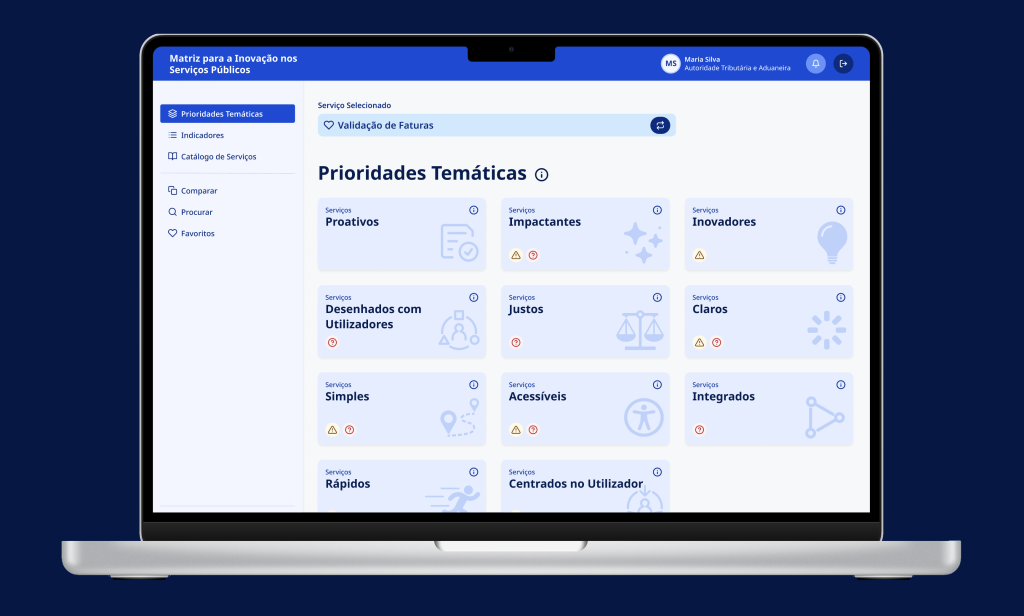
The Matrix of Innovation in Public Services (MATRIX) directly addresses this challenge by providing a unified digital tool to measure service performance and track effectiveness. Developed by ARTE/LabX with OECD/OPSI support, MATRIX consolidates user experience data, administrative data, and regulatory indicators into a single analytical framework organised around 9 dimensions of service performance. This allows organisations to detect gaps, compare services, monitor improvements over time and understand how services contribute to wider public policy goals.
MATRIX’s purpose is to make performance measurement practical, actionable and aligned with real decision-making. It enables public servants to quickly identify where services are underperforming, quantify challenges, and direct innovation efforts to areas where they can create the most value. The tool provides visual dashboards that highlight trends, show demand across delivery channels, and expose inefficiencies that would otherwise remain hidden. By linking observed issues directly to concrete methods and guidance for innovation, MATRIX builds the capacity of teams to implement targeted, high‑impact improvements.
Developed through extensive co-creation, prototyping and piloting—covering 10 services in its first phase—MATRIX proved easy to use and effective in supporting evidence-based decisions. It achieved a System Usability Scale score of 81.2 and was widely recognised as a powerful resource to inform service planning, prioritisation and coordination. Users at strategic, operational and cross‑government levels reported that the tool helped them understand performance in ways previously impossible.
Now in Phase 2 (2026), MATRIX is being expanded to 25 public services across five organisations. This phase will deepen its capacity to generate consistent and high‑quality data, especially regarding user experience, and strengthen its role as a practical instrument for tracking progress and evaluating service improvements. The long‑term vision is to embed MATRIX as a core part of Portugal’s public administration—ensuring services are continuously monitored, evidence informs improvement, and public value is demonstrably increased over time.
Innovation Description
What Makes Your Project Innovative?
The MATRIX is innovative because it introduces a unified, data‑driven way for public organisations to understand and improve service performance. It transforms more than 600 dispersed indicators into a clear framework of nine dimensions, integrating user experience, administrative and regulatory data into one coherent view. This makes gaps, trends and opportunities visible in ways that were previously impossible.
What truly sets the tool apart is its ability to move users from insight to action. MATRIX does not only identify issues—it links each dimension to practical case studies, guidance and proven innovation methods, helping public servants design targeted improvements with confidence. Developed through extensive co‑creation and iterative testing across multiple organisations, it aligns monitoring practices and strengthens evidence‑based decision‑making, supporting a more effective and accountable public administration.
What is the current status of your innovation?
The 1st phase has been successfully completed and the solution is now being scaled to test it in real-world conditions and improve its usability.
Innovation Development
Collaborations & Partnerships
The project was co-developed by ARTE/LabX and the OECD with contributions from public servants across multiple Portuguese organisations. Stakeholders shaped the framework, indicators and prototypes through workshops, interviews and testing sessions. An international taskforce with 24 countries and the European Commission also contributed insights. During 1st phase, the Cohesion Policy Agency, Tax Authority and Social Security Institute participated with 3 services each.
Users, Stakeholders & Beneficiaries
Primary users are public servants who manage, monitor or improve public services. Beneficiaries include strategic leaders, service managers and cross-government coordinators who rely on data to plan improvements. Ultimately, citizens and businesses benefit from more efficient, simplified and user-centred services informed by MATRIX insights.
Innovation Reflections
Results, Outcomes & Impacts
In the 1st phase, the project created a structured evidence base for service improvement by analysing 600+ existing indicators and organising them into a coherent framework of 9 pilots across 10 services demonstrated that MATRIX enables public organisations to more accurately assess service performance, identify bottlenecks and track the effectiveness of improvements. Its usability score of 81.2 reflects its clarity and ease of adoption. Users reported better visibility into service demand, data gaps, and performance trends, improving their capacity to make evidence-based decisions. Phase 2 will extend these measurement capabilities to 25 services across 5 public entities enhancing consistency and reliability of monitoring across government.
Challenges and Failures
A key challenge was the fragmented nature of monitoring practices, which made it difficult to gather comparable performance data across organisations. User experience data was often limited or missing. Early prototypes showed that indicators and dimensions needed simplification to make measurement intuitive. Through iterative testing, terminology was refined, data visualisation improved and technical sheets strengthened. Remaining challenges relate to data coverage and the capacity of organisations to collect higher‑quality performance information.
Conditions for Success
Success relied on access to administrative data, strong governance and clear alignment with existing regulatory and monitoring frameworks. Collaboration with OECD experts ensured methodological rigour, while public servants’ participation ensured relevance to real monitoring practices. Iterative testing helped validate how performance information should be structured and used. A supportive environment encouraging measurement, learning and improvement was essential for the tool to be effective.
Lessons Learned
Efforts to innovate public services must begin with understanding what is happening on the ground. MATRIX showed that combining different data sources—operational, user experience and regulatory—creates a much clearer picture of service performance. Co‑creating the tool with users ensured that measurement approaches matched real organisational needs. Iterative testing revealed the importance of simplifying frameworks and supporting teams with clear guidance for interpreting and using data to drive improvements.
Status:
- Implementation - making the innovation happen
Innovation provided by:

Media:
Date Published:
25 September 2026