

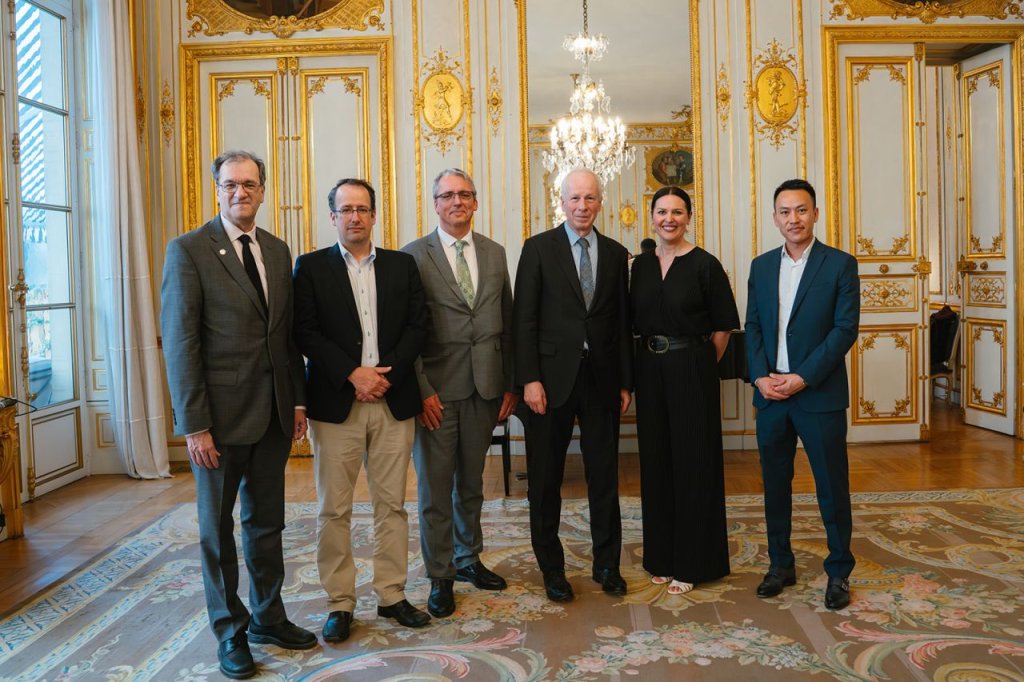
Francis LeBlanc of UMoncton and Frederic Doire of Dassault Systèmes at launch of pilot project - VIVATech 2025
New Brunswick faces an urban development challenge driven by record population growth, which also impacts biodiversity flow on the outskirts of urban regions. This Project used advanced virtual simulation technology to help municipalities evaluate urban development and infrastructure solutions before implementation. By creating digital replicas of cities and rural land use, decision-makers can test hundreds of scenarios and make evidence-based choices that improve territory management.
Innovation Summary
Innovation Overview
Record population growth in New Brunswick has created significant pressure on housing markets, leading to severe shortages affecting vulnerable populations including students and seasonal workers. Between 2020 and 2024, New Brunswick added 76,474 residents—almost as many as in the prior 40 years combined. This surge resulted in home prices increasing 89% and monthly rent jumping from $800 to $1,250 for typical two-bedroom units. The province needs to construct 6,000 new homes per year while simultaneously addressing mobility, urban development, economic growth, social acceptance, and environmental sustainability.
The Virtual Twin Pilot Project deploys Dassault Systèmes' 3DEXPERIENCE platform to create virtual replicas of municipalities in the southeastern region of New Brunswick. Led by Université de Moncton (UMoncton) in partnership with the Cities of Moncton and Dieppe, as well as the Collège communautaire du Nouveau-Brunswick (CCNB) and the Southeast Regional Service Commission (Southeast RSC), this platform enables stakeholders to simulate and evaluate development alternatives using multidisciplinary criteria. Virtual twin technology goes beyond traditional digital modeling by creating a true-to-life virtual environment where experimentation occurs safely before resources are invested in real-world implementation.
The pilot project aimed to:
1. Map the territory's reception capacity based on available spaces, housing, and services;
2. Implement management and enhancement of territorial data;
3 .Propose and evaluate alternative solutions for mobility, housing, urban and economic development, and environmental impact;
4. Provide communication elements for constructive dialogue with all ecosystem players including citizens, elected officials, and stakeholders.
It also was a chance to integrate experiential learning for UMoncton students through 5 internships with Dassault Systèmes’ team.
Primary beneficiaries include municipal governments gaining decision-support tools, citizens receiving better-planned communities, students and vulnerable populations benefiting from improved housing availability, and businesses operating in a more competitive economic environment. The project also positions New Brunswick as a national leader in urban transformation using digital tools.
Following the successful six-month pilot (June 2025 – January 2026), the project establishes what a Center of Excellence for digital transformation of public institutions should achieve: mobilize public institutions around complex challenges, attract private digital ecosystem, develop academic cursus to develop and recruit local talent and leverage local expertise and experience from Dassault Systèmes as a digital partner. The roadmap includes progressive deployment of digital solutions province-wide, talent development, and internationalization of expertise.
Innovation Description
What Makes Your Project Innovative?
The project was a world-first at this level and represents a paradigm shift in municipal planning through three key innovations:
1. Advanced Virtual Twin Technology - Unlike traditional digital twins that simply replicate physical assets, the UMoncton-led virtual twins create interactive 3D environments where all stakeholders share the same view and data, enabling holistic evaluation of various factors simultaneously.
2. Generative Urban Planning - Municipalities can now evaluate hundreds of development alternatives automatically based on configurable criteria and external factors, moving beyond manual scenario planning to AI-assisted optimization.
3. Multi-stakeholder Collaborative Platform - The innovation breaks down silos by providing stakeholders access to a unified decision-making platform, fostering unprecedented cross-sector collaboration on complex societal challenges.
What is the current status of your innovation?
The six-month pilot is now in the evaluation phase. Early feedback from urban planners in Moncton and Dieppe highlights the platform’s speed and data-driven insights. CCNB and UMoncton are exploring its role in long-term student housing planning as well as other applications, while the Southeast RSC has begun integrating biodiversity corridor findings into ongoing planning. Final results will support the establishment of the proposed national Center of Excellence.
Innovation Development
Collaborations & Partnerships
The project demonstrated deep public-private-academic collaboration. UMoncton’s leadership, with Dassault Systèmes, enabled the development of a collaborative digital platform as well as overall project management. UMoncton also provided research capacity and delivered training. This work was supported by two New Brunswick SMEs, The Black Arcs and Remsoft. Two municipalities, along with CCNB and the Southeast RSC, contributed their local knowledge, use cases, and operational testing.
Users, Stakeholders & Beneficiaries
Urban planners, elected officials and subject matter experts (environment, biologist, mobility) use the platform to support data-driven decisions on densification, zoning, and infrastructure. Citizens benefit from a clearer understanding of projects, strengthening social acceptability.
Students gain improved access to housing, while CCNB and UMoncton optimize their student housing investments. Finally, researchers and students gain access to cutting-edge technology and develop skills.
Innovation Reflections
Results, Outcomes & Impacts
The intended impact of the pilot project was to transform municipal decision-making from intuition-based to evidence-based planning, accelerate urban planning approvals through better stakeholder communication, and establish New Brunswick as a North American leader in virtual twin technology for territory management.
Results are still preliminary but two municipalities deployed virtual twins for targeted use cases; the Southeast RSC applied multi-criteria parcel filtering to prioritize acquisitions supporting a viable biodiversity corridor between Nova Scotia and New Brunswick; and CCNB and UMoncton evaluated long-term regional capacity for student housing investments.
Challenges and Failures
Data Collection Challenges: Initial data integration required significant effort to harmonize datasets from multiple municipalities with different formats, standards, and quality levels.
Stakeholder Learning Curve: Not all participants had familiarity with advanced virtual twin concepts, creating initial hesitation. Training sessions were developed and application engineers provided hands-on support during the implementation phase.
Scope Management: With diverse partners having different priorities, maintaining focus on achievable pilot objectives while managing expectations for broader applications proved challenging. Dedicated and frequent workshops were implemented to include all project stakeholders.
Conditions for Success
The project succeeded because of strong commitment from ecosystem leaders willing to embrace innovative approaches to urgent urban development challenges. The multipartite collaboration brought complementary strengths. Academic research rigor, government operational knowledge, and industry technological innovation created a robust ecosystem for innovation. Combined federal, provincial, and partner contributions demonstrated shared commitment and distributed risk, making the project financially viable. Finally, collaboration with Dassault Systèmes as well as The Black Arcs and Remsoft, brought world-class expertise and technology to the table,
Lessons Learned
Start with Concrete Use Cases: Rather than building comprehensive virtual twins immediately, focusing on specific municipal challenges (Mountain Road Master Plan, biodiversity corridor) provided tangible value quickly and built stakeholder confidence.
Invest in Training: Technology alone doesn't create change—people do. Allocating 22% of the budget to research interns and training ensured users could effectively leverage the platform's capabilities.
Co-construction is Essential: Pre-pilot collaboration with partners to define challenges and use cases created ownership and ensured the platform addressed real needs rather than theoretical problems.
Anything Else?
For the region, this project represents more than a technology demonstration, it's a foundation for New Brunswick's digital transformation strategy. The housing crisis provided the catalyst, but the platform's applications extend to circular economy development, production chain improvement, future investment planning, business attraction, and talent development. The virtual twin approach positions a traditionally under-resourced province as a North American innovation leader, demonstrating how strategic partnerships and targeted investments can leapfrog conventional development paths.
Status:
- Evaluation - understanding whether the innovative initiative has delivered what was needed
Innovation provided by:

Media:
Date Published:
29 September 2026