

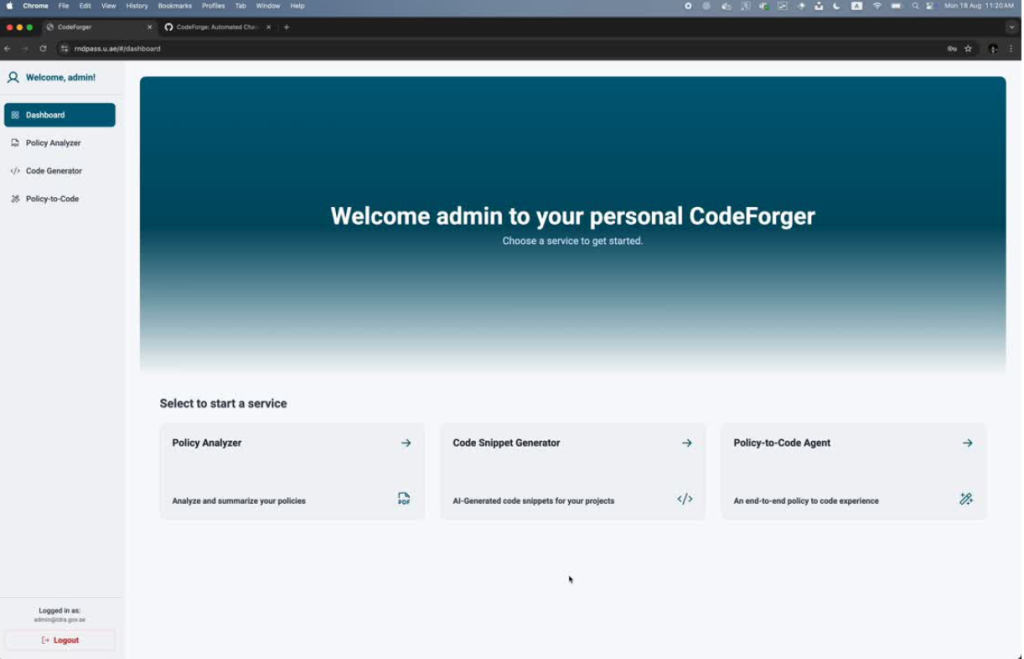
Government entities often face delays and inconsistent implementation because complex digital policies are difficult to translate into clear technical action. DGCP is an AI-enabled platform that converts policy documents into actionable technical requirements and implementation-ready outputs, helping government teams deliver more compliant and consistent digital services. It is innovative because it connects policy interpretation and technical execution in one workflow.
Innovation Summary
Innovation Overview
Government entities face a persistent challenge of translating complex, frequently evolving technical policies into consistent, actionable implementations across digital services. This has resulted in fragmented compliance, manual interpretation processes prone to human error, and significant delays in implementation and audit cycles. Policies passed through business leads to technical teams increase the risk of translation errors and misalignment, slowing service delivery and undermining regulatory intent. Many entities also depend on external technical vendors to bridge expertise gaps, driving up costs and extending timelines, thus, resulting in a system that is reactive, inconsistent, and difficult to scale.
The Digital Government Compliance Platform (DGCP) addresses this through a "policy-as-code" platform that transforms regulatory and policy documents for digital government services into machine-readable, implementation-ready technical requirements. AI-powered agents automatically extract actionable requirements from uploaded policy documents, map them to each entity's system architecture, and generate tailored, standards-aligned code ready for direct codebase integration. This eliminates the translation gap between policy intent and technical execution, enabling business and technical users to interpret and implement policies consistently within a single unified platform, simplifying compliance for non-technical users while automating execution behind the scenes.
DGCP’s goal is to eliminate policy translation gaps, reduce implementation timelines, standardize regulatory interpretation nationwide, and build in-house government capability. Its beneficiaries include UAE federal and local government entities, business and technical leads, and policy-makers and auditors evaluating compliance. UAE residents will ultimately benefit from more compliant and consistent digital services. Early pilot activities has demonstrated measurable potential, including reduced implementation cycles, improved consistency, and decreased vendor reliance.
Looking ahead, DGCP is designed for national scale, embedded into digital service development workflows as a standard tool for policy onboarding and compliance across government domains. With the launch of the Prime Minister’s Office Regulatory Intelligence Ecosystem initiative, we recognized strong alignment with its vision and are evolving DGCP to serve as a core enabler for operationalizing policies at scale within this ecosystem. This positions the platform as a cross-government capability supporting federal entities across sectors such as health, finance, and digital services. The ambition is to shift compliance from reactive to proactive through continuous, automated implementation. In the long term, DGCP aims to establish a unified standard where compliance is seamlessly embedded into every digital service, while positioning the UAE as a global leader in AI-driven digital governance.
Innovation Description
What Makes Your Project Innovative?
Existing "rule-as-code" approaches require regulations to be manually written into static, machine-readable formats, which are rigid, time-consuming, and industry-specific. DGCP goes further with a dynamic "policy-to-code" model powered by AI. Its agents read policy documents, analyze each entity's system architecture, and autonomously embed tailored, executable code directly into its codebase, making every implementation custom-generated per entity.
Unlike solutions that focus on policy interpretation or compliance assessment, this delivers a compliance platform covering policy analysis, requirement extraction, and automated code generation. This eliminates the disconnect between business and technical execution, transforming compliance from a fragmented, manual, and one-time activity into a continuous, automated, and traceable process. As an end-to-end "policy-to-code" platform, DGCP is a first-of-its-kind innovation at government-wide scale, both in the UAE and globally.
What is the current status of your innovation?
DGCP has progressed beyond concept and has been validated through multiple real-world use cases. Initial pilots have demonstrated the ability to extract policy requirements, generate actionable outputs, and support automated compliance workflows. The platform is currently advancing through development, pilot onboarding with selected federal entities, and preparation for scaled deployment across the UAE digital government ecosystem.
Innovation Development
Collaborations & Partnerships
DGCP was developed through collaboration with TDRA leadership and policy owners, the Digital Dubai Authority (DDA), and the Prime Minister’s Office. TDRA and DDA provided design system and UAE PASS guidelines for pilot validation. Internal policy teams shared insights on policy challenges, while government entities tested real use cases to validate impact. The PMO expressed intent to support scaling by connecting the platform with chief innovation officers across the UAE to drive adoption.
Users, Stakeholders & Beneficiaries
Primary users include government and private sector entities (business and technical teams) responsible for implementing digital services and complying with policies. Internal stakeholders include policymakers, auditors, and compliance teams who benefit from standardized implementation, faster audits, and improved compliance. Citizens benefit from more consistent, reliable digital services as compliance is embedded by design.
Innovation Reflections
Results, Outcomes & Impacts
DGCP transforms compliance from a reactive, manual process into a proactive, AI-driven capability by translating policies into machine-readable requirements and code. It standardizes interpretation, accelerates implementation, and enables continuous compliance across government entities. Early pilots demonstrated up to 98% reduction in development time, with a typical compliance update executed in 35 minutes versus up to one week previously, projecting AED 408-512K in savings and 7,400 hours recovered per compliance task across UAE federal entities. Policymakers highlighted strong value in early-stage implementation, expecting reduced manual feedback and clearer guidance, enabling real-time compliance instead of periodic reviews.
Challenges and Failures
Accurately extracting consistent, actionable requirements from ambiguous policies was a key challenge, addressed through iterative prompt engineering, structured translation methods, and robust guardrails. Managing complex codebases also posed limitations in analyzing full systems at once; this was resolved by breaking code into smaller sections, improving accuracy while strengthening data isolation and security. Initial mistrust in AI outputs was mitigated through human-in-the-loop validation, ensuring all outputs are reviewed by technical leads before production. Security concerns were further addressed through strict guardrails, zero data retention, and on-premise deployment, enabling safe adoption in sensitive government environments.
Conditions for Success
Success was driven by strong leadership support and alignment with national digital government priorities, including the Regulatory Intelligence Ecosystem. TDRA’s role as both regulator and enabler provided unique insight into policy intent and real implementation challenges. Close collaboration between policy experts, AI engineers, and government stakeholders (DDA) ensured practical applicability. A supportive R&D environment enabled rapid experimentation, iterative development, and continuous feedback from entities. Access to emerging AI technologies, real pilot use cases, and governance frameworks with human oversight strengthened trust, scalability, and adoption, further validated by strong interest from multiple government entities.
Lessons Learned
AI can notably enhance government operations, but human oversight is essential – it’s not a limitation, but a foundation for trust and accountability. Resistance to AI is natural; demonstrating clear value, ease of use, and integration into daily workflows is key to adoption. Positioning AI as an enabler rather than a replacement helped shift mindsets, especially among technical users. Continuous user engagement was critical in early stages as feedback reshaped the solution from a purely technical tool to one addressing real policy implementation challenges. We also learned to prioritize high-impact capabilities over feature volume, and that rapid, iterative testing accelerates improvement far more effectively than building in isolation.
Project Pitch
Status:
- Implementation - making the innovation happen
- Evaluation - understanding whether the innovative initiative has delivered what was needed
Innovation provided by:

Media:
Files:
Date Published:
29 September 2026