


Sharing services, maximizing results
In order to enable strategic ministerial expansion without increasing costs, ColaboraGov centralizes the sharing of administrative support services among 13 ministries. It ensures savings in resources, gains in scale and quality, and standardized service provision. It comprises more than 41,000 civil servants, 374 services and has an impact on 10 areas - such as human resources, finance and logistics - thus making it easier for the government to direct its efforts towards final public policies.
Innovation Summary
Innovation Overview
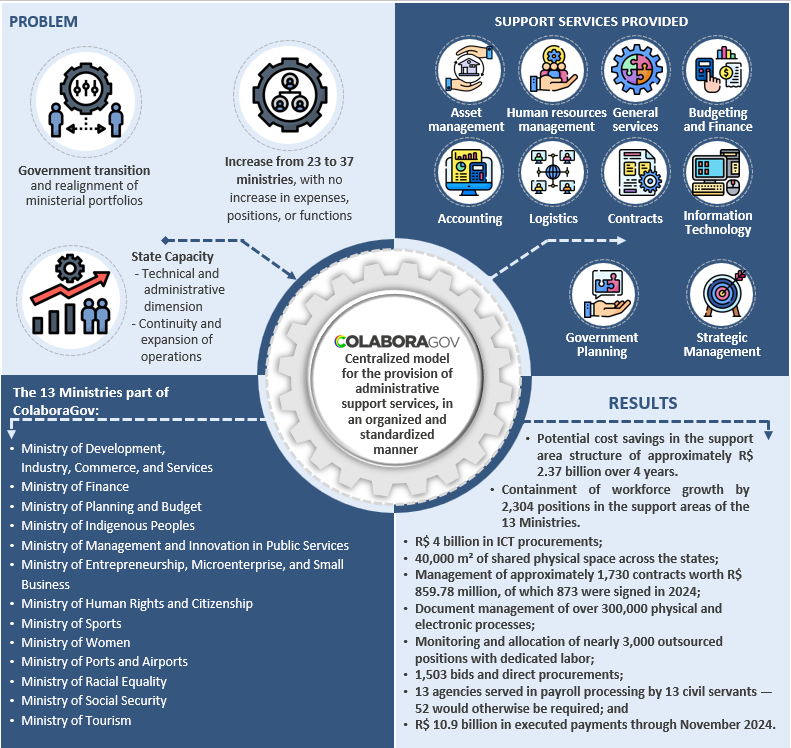
Strengthening state capacity and pursuing efficiency and excellence in service delivery are common challenges faced by governments and public administration. However, crafting effective solutions requires close attention to local context. During Brazil’s government transition (2022–2023), the newly elected administration reorganized its organizational structure to implement new public policies. As part of this effort, the number of ministries was increased from 23 to 37. Key ministries were created or reinstated, such as Culture, Sports, and Social Development. However, this proposal faced constraints that had to be addressed: the process could not result in increased expenses or number of public positions.
Based on the premises that a collaborative arrangement would allow for resource sharing among agencies to achieve results not possible individually, and that a centralized model for delivering administrative support services in an organized, standardized, and more efficient manner would enhance state capacity, the ColaboraGov initiative was created. The short implementation timeline, along with the need to maintain essential services—such as procurement and payroll—while simultaneously structuring the new operating model, posed significant challenges.
It is important to highlight that many of the administrative support areas for the new ministries established in 2023 were created under a different format than the traditional model: with 36 personnel compared to an average of 228. This was intended so that the unit would act solely as a management support hub, handling requests between the ministry and the new shared administrative support services unit.
The first implementation stages of ColaboraGov in 2023 focused on structuring project management, governance tools, and regulations, while also organizing a wide range of processes and stakeholders. This involved combining management tools, resources, and organizational structures to enable shared services. The creation of the Ministry of Management and Innovation in Public Services (MGI)—the body leading ColaboraGov—aimed to simultaneously ensure the sustainability of public sector administrative capacity and drive innovation.
ColaboraGov’s implementation is grounded in technological innovation (including the development of systems and automation), process improvement, and the establishment of a solid governance model. The estimated savings from the policy amount to R$ 1 billion over four years. At the same time, the shared services model promotes specialization, standardization, and quality improvement, thereby strengthening the ministries' capacity to implement their core public policies. In this way, ColaboraGov benefits both the participating ministries and society at large. With the consolidation of the model, it presents potential for future expansion within the Brazilian Federal Government.
Innovation Description
What Makes Your Project Innovative?
Development supported by strengthening state capacity is a common goal among governments, and different strategies can be implemented to achieve it. In this ongoing challenge of “how to make it happen,” ColaboraGov stands out as an innovative initiative built on five key pillars. First, its scale and coverage — involving cooperation among 13 ministries, in 10 support areas and engaging 41,000 civil servants. Second, an innovation strategy focused on process mapping and redesign, which drives short-term results. Third, the prioritization of existing government resources — technical capacity, technology, and personnel. Fourth, a commitment to social and environmental sustainability, exemplified by quotas for hiring women who are victims of violence. And finally, the capacity for replication and expansion of the model in different governmental levels. By innovatively combining state resources, ColaboraGov has become one of the largest Shared Services Centers in the world.
What is the current status of your innovation?
The ColaboraGov project is currently in the stabilization and consolidation phase of its model. For this year, important actions are planned, including the design and implementation of quality indicators, modernization of the procurement process, development of tools and methodologies for cost-sharing, and the strengthening of the model’s regulatory and governance structures.
In addition, the project's 70 deliverables will be monitored through the lens of innovation — whether incremental, adjacent, or disruptive. Another priority in this phase is sharing, with other countries, the experience and knowledge accumulated on Shared Services Centers, by means of an international event and bilateral engagements.
As of June 2025, the project had achieved 45% of its planned annual targets, according to internal monitoring data, creating opportunities for continuous and sustainable improvement, and the development of service-sharing solutions.
Innovation Development
Collaborations & Partnerships
Collaboration first took place during the design of the project, within the 2022–2023 Government Transition Office. Later, under the leadership of the MGI, ColaboraGov was implemented through coordinated efforts by six departments of the Shared Services Secretariat. Ministries joined the project in 2023, with the formalization of the Governance Model. Oversight bodies, such as the Federal Court of Accounts (TCU) and the Office of the Comptroller General (CGU), were also key partners.
Users, Stakeholders & Beneficiaries
Today, ColaboraGov involves 41,125 civil servants across approximately 20 different civil service careers, including technology analysts and administrative staff. These professionals have benefited from the standardization and gains in quality and efficiency made possible through shared services. ColaboraGov also directly benefits society through an estimated cost saving of R$ 1 billion over four years, as well as by strengthening state capacity for the implementation of core public policies.
Innovation Reflections
Results, Outcomes & Impacts
Among the positive impacts of ColaboraGov are the mapping and redesign of 800 processes, the management of 1,730 active contracts, and a reduction of 2,304 positions in the support workforce. Additionally, the estimated cost savings are R$ 1 billion over four years. The project also enabled the execution of over R$ 11 billion in annual payroll, managed by just 13 staff members — a task that would have required 52 civil servants without ColaboraGov. Beyond administrative services, the project supported key government initiatives, such as the contracting of the examining body for the first Unified National Public Competition, which had over 1 million applicants, and the emergency procurement of food for the Yanomami Indigenous people.
Challenges and Failures
One of the main challenges faced in the implementation of ColaboraGov was the need to develop an innovative model for delivering shared services — including the redefinition of roles and responsibilities with participating ministries — while simultaneously maintaining essential services, such as contract management and personnel operations. Additionally, it required the adaptation and development of systems, regulations, processes, and organizational structures to meet the demands of a model involving 13 ministries within a short timeframe. In response, ColaboraGov invested in restructuring personnel, establishing regulations and governance models, and prioritizing necessary transformations in strategic processes and systems.
Conditions for Success
In addition to factors such as strategic management, the governance model, and project management — all of which were critical to the successful implementation of ColaboraGov — the technical and human competencies for innovation played a key role in the process. The high level of specialization among civil servants enabled the centralization, standardization, and improvement of shared services. Leadership competencies also helped create the spaces for dialogue and collaboration that were essential for strategically driving the project (Figure 5). The development of regulatory and bureaucratic structures was likewise fundamental to enabling the implementation and operation of ColaboraGov.
Replication
ColaboraGov can be replicated by governments in different levels, as it presents a validated model that makes it possible to share services on a large scale and with wide coverage in the short term. It is a model that adds complexity and multi-stakeholder coordination to the experiences of existing Shared Services Centers, generally focused on specific areas of collaboration. As such, it offers relevant contributions to public managers, both for new implementations and for improvements to current SSCs. Also noteworthy is the effort to record the process innovations and management solutions achieved by ColaboraGov, in order to share experiences and continuously evolve the model.
Lessons Learned
The ColaboraGov project highlighted the importance of interministerial collaboration for the legitimacy and success of public initiatives by involving various stakeholders. The adaptation of management tools, such as Microsoft Project and BI, proved crucial, considering the organizational maturity level required for effective management. Internal coordination revealed challenges in implementation, exposing gaps in knowledge regarding bureaucracy and cognitive biases. Furthermore, the existing organizational structure was shown to limit the expansion and improvement of services, indicating the need for new arrangements. These insights provide a solid foundation for future implementations and studies in public management.
Anything Else?
The ColaboraGov project goes beyond organizational and process innovation: it is a model that institutionalizes a state project, a legacy for public management, demonstrating the execution potential of the technical team involved, the leadership, and the good ideas put to service for society. In this sense, there is a desire to share this Brazilian experience with other governments, private sector actors, the third sector, and multilateral organizations, creating opportunities for cooperation, learning, and knowledge exchange.
Project Pitch
Status:
- Implementation - making the innovation happen
Innovation provided by:

Media:
Date Published:
4 March 2026