
The Future Tech Challenge (FTC) is a pilot initiative led by DPER to connect and collaborate across the wider ecosystem, and engage in transformative innovation by experimenting with, and applying new technology to address pressing public sector problems and opportunities that deliver improved services to the public. Drive innovation using emerging technology, enhance collaboration, meet National strategic priorities, generate knowledge & learnings and develop prototyped solutions.
Country: Ireland
Case Study
Driving Artificial Intelligence in Public Services through accredited upskilling and project…
The Foundation Certificate in AI project seeks to make Ireland a world-leader in the ethical application of Artificial Intelligence across the Irish civil and public services by 2030 and is in line with the digital ambition, which the government of Ireland set itself. The project aims to upskill/reskill Irish Civil & Public Servants, identify a pipeline of potential AI projects that can improve service delivery, deliver value for money and is aligned National Strategy in AI & Innovation.
BI Project
Can Visual Cues to Portion Size Reduce the Number of Portions of Consumed? Two Randomized Controlled…
Methods
Two preregistered randomized controlled trials (N = 253 and N = 674) measured consumption in a lab and the home environment. Cues were salient, labeled stripes that demarcated single portions. Participants were randomized to cue condition or control. Consumption was measured without awareness.
Results
The main preregistered effect of the visual cue was not statistically significant. There was some variation by subgroup. In Study 1, men were more likely to eat the whole can of potato…
Contact-tracing mobile phone apps have the potential to play a role in controlling
the spread of COVID-19, but their success hinges on widespread uptake by the public. We
report a study that behaviourally pre-tested COVID Tracker, Ireland’s contact-tracing app,
prior to its launch with a large sample of smartphone users. The study was funded by the
Department of Health and run in co-operation with the app’s developers, NearForm.
Participants were randomised to receive different versions of a…
Online experiment tested two novel public health messages on social distancing.
•Messages focused on potential to infect vulnerable people or many people.
•Participants (N = 500) randomized to see control or (one of two) treatment posters.
•Behavioral intentions and acceptability judgements of behaviors measured later.
•Both posters increased caution with respect to social distancing.
Case Study
The ‘Integrated Patient Journey Map’: A Design Tool for Embedding the Pillars of Quality in…
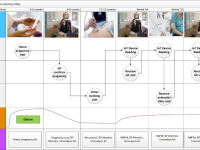
IPJM offers a constructive tool for multi-disciplinary teams to work together in designing healthcare solutions, through mapping the physical and emotional journey of patients for both the current service and the proposed service reform. It supports groups in understanding and negotiating the conflicting requirements that can arise during transformational projects. This is achieved using journey mapping and user personas for graphically externalising key domain knowledge.