
Skip to content
An official website of the OECD. Find out more
Created by the Public Governance Directorate

This website was created by the OECD Observatory of Public Sector Innovation (OPSI), part of the OECD Public Governance Directorate (GOV).

How to validate authenticity

Validation that this is an official OECD website can be found on the Innovative Government page of the corporate OECD website.

View as: Map

Filter by:

Countries

Level of government

Sector

Year of launch

Stage of innovation

Recognition

Innovation Tags

Innovations:
0
This website, as well as any data and map included herein, are without prejudice to the status of or sovereignty over any territory, to the delimitation of international frontiers and boundaries and to the name of any territory, city or area.
Renovate or Rebuild was a collaborative project that set out to increase the uptake of sustainable homes in the Australian residential sector. The show took an innovative approach to embed behavioural and building science into an engaging, yet informative and impactful TV series, that promoted and normalised sustainable homes. Research estimates this project could save Australians $600 million on their energy bills and would cost less than $1.60 for every tonne of greenhouse gas abated.
The Startup GOV.BR Program aims to accelerate strategic digital projects at federal government in an unprecedented and innovative way. By providing technological tools, allocating professionals and assisting them to adopt agile methodologies, it supports a 30-crosscutting-project portfolio with several federal agencies. The initiative has promoted a paradigm shift in the management of public digital solutions, incentivizing agility, resilience and value generation for citizens and general users.
Digitalization of government often refers an individual project but should include on-going projects. Our city has been building the foundation that allows us to digitalize pubic services simultaneously. Shibuya collects city data and make it open so that innovators could collaborate with us. Secondly we educate our people. Shibuya provides digital devices to children and senior citizens. Thirdly, we let startups to test their product in the city. Finally we will institutionalize the actions.
Impact Canada Challenges have incentivized innovative solutions in the areas of climate action, housing, food, and health. A quasi-experimental impact assessment approach uses tax data (available in most countries) to assess the effectiveness of Challenges by profiling Challenge participants and comparing business performance indicators of Challenge participants vs. non-participants. Requiring only the participant’s business number, this is a no burden, comparative, long-term measurement plan.
Shanghai Data Exchange (SDE) has initiated a new business racing track of data factor market. SDE has independently developed a data trading system named niDts Intelligent Data Trading System, which provides efficient, convenient, transparent and secure data trading services, enabling the market development of data as a production factor, and fueling the digital transformation of economy, life and governance.
Intergenerational fairness—the idea that we should meet the needs of the present without compromising rights of future generations or citizens—is a defining theme of our time. Although most politicians and citizens value fairness, society does not have a way to assess the impact we’re having on future generations and advocate for them. This Framework for Intergenerational Fairness contributes to this. The Framework provides a pragmatic solution, whether as a young citizen, or public…
A problem for companies and owners of companies is that they need to engage with many different authorities to conduct their business. Instead of building solutions in a siloed approach we aim to build into the ecosystem by integrating different actors and enabling the business to control their own data using blockchains and digital wallets. This is both a new approach and use of a combination of new technologies that benefits the companies.
During the Russian invasion of Ukraine, relief organizations and government agencies lacked data about events on the ground and struggled to mount an effective response. New methods of event detection were urgently needed. A research team comprised of country experts and computational social scientists created a Twitter-based event detection system that provides geo-located event data on humanitarian needs, displaced persons, human rights abuses and civilian resistance in near real-time.
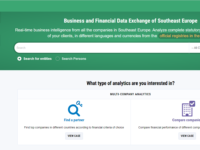
Countries in the Western Balkans created digital infrastructure to support transparent business operation and prevent fraud in their Common Regional Market. The official registries from 5 countries in the Western Balkans created a digital platform, connecting all official legal and financial data about companies, connected entities, blocked bank accounts and sanctioned persons, bridging different legislations, languages and currencies. The platform won the 2022 OECD/SIGMA/ReSPA award.
Governments around the world are censoring the Internet, but how can we document, track, and respond to Internet censorship events? In 2022, the Open Observatory of Network Interference (OONI) launched the Measurement Aggregation Toolkit (MAT) which hosts one of the largest open datasets on Internet censorship to date. In real-time, new measurements are published from around the world, enabling researchers, journalists, and human rights defenders to track and respond to censorship worldwide.