
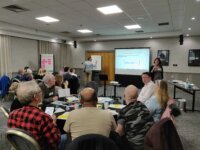
Scottish Government commissioned research to explore public attitudes to agriculture, environment and rural priorities in Scotland, to develop replacements to the Common Agricultural Policy. The research involved a number of strands of data collection, with each element building on the other, and culminating in citizens' forums to develop a detailed understanding of public priorities. The research is being used by policymakers as a new Scottish Bill is in the process of being developed.
Country: United Kingdom

In England, provision of and funding for adult social care has been subject to numerous reports, commissions and Government papers which have failed to produce agreement on how to tackle the urgent need for reform.
Involve was commissioned by two UK Parliamentary Committees to run a citizens’ assembly – a representative sample of the English public – to inform their joint inquiry on the issue.
It was the first time a UK Parliament has ever run a citizens' assembly to gather public views.
Adur and Worthing Councils implemented a low code development platform to help them take control of their digital transformation. A small digital team is building end-to-end user-centred digital services that are replacing expensive and inflexible legacy systems. Low cost, fast and flexible, this pioneering digital strategy has delivered multiple customer and efficiency benefits, won national awards and central government recognition.
The integration of health and social care was seen by the Scottish government to require support to ensure that benefits of both national and local data and knowledge were able to be shared across two very different cultures and service providers to jointly develop more appropriate services for local populations.
LIST using their expertise in analytical work was seen as a way to develop a sound evidence base to allow decision makers to develop effective services.
The Northern Ireland (NI) Public Sector Innovation Lab has organised a hackathon, “Hack the Pain,” to address these needs of an underserved group: people with persistent pain. These individuals need for better information services for self-management, and the projects that emerged from the hackathon include a virtual reality app for mindfulness, a pain tracking app and a website of information on pain management techniques.

Αugmented Nature is a set of robotic tools that help animals adapt to the mass extinction. The tools enhance the capacities of so called Ecosystem Engineer species to reclaim and change their own habitats.
The council of the London Borough of Barking and Dagenham is committed to ensuring no residents are "left behind". The population of the borough experiences the highest level of deprivation in the London and has historically struggled with many social and environmental indicators of success. Coupled with central government mandated austerity, the local authority required a strategic decision-making tool to illustrate at a community level where the most investment is needed to improve outcomes.
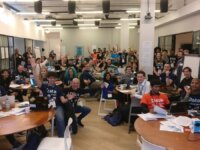
The Office for National Statistics (ONS) Data Science Campus was set up to work at the frontier of data science and Artificial Intelligence (AI), to deliver research with impact and build capability across the UK public sector. We build skills and apply tools, methods and practices; creating insight to improve decision-making for public good. We work with UK and international partners, drawing on their expertise and resources, sharing the benefits of our education and research programs widely.
The Government Digital Service and the Ministry of Housing, Communities and Local Government launched the Local Digital Declaration to support and unite local authorities around a shared understanding of good digital practice.
It is a unique call to action that addresses the legacy IT contracts, isolation of procurement practices and siloed digital projects that have left local government services vulnerable to high delivery costs and low customer satisfaction for the public they serve.
Globally, public procurement is in desperate need of reform and must embrace the tools, techniques and culture of the digital age. It’s a government’s top corruption risk as it’s where money and discretion collide.
The UK has begun to address this; GDS is leading the Global Digital Marketplace project, which is embedding user-centred, design-led, data-driven and open approaches across digital, data and technology planning, procurement, contracting and service delivery.