
Transport Canada has piloted the use of Artificial Intelligence (AI) to perform risk-based oversight by scanning Pre-loading Advance Cargo Information (PLACI) to identify potential air cargo threats (i.e. “bomb-in-a-box” scenario). By using AI to perform this function, there is potential for Transport Canada to save 1,000’s of hours and conduct risk assessments on all air cargo shipments coming from abroad -- in real-time.
Global: Artificial Intelligence
Open policy-making is an opportunity for government and stakeholders to move from linear, polarized, single-issue, interest-based considerations to interactions that are networked, collaborative, opportunity-based and where complexity is viewed as an asset. Adapted for the Government of Canada context, Pol.is is a cost-effective and highly scalable, digital engagement platform that can be used as part of broader strategies to put people and robust evidence at the heart of government decisions.
Case Study
Unlocking the potential of crowdsourcing for public decision-making with artificial intelligence
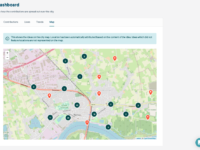
In citizen participation projects, analysing contributions is often a huge challenge for administrations.
CitizenLab has developed machine-learning algorithms in order to help civil servants easily process thousands of citizen contributions and efficiently use these insights in decision-making.
The dashboards on our platform classify ideas, show what topics are emerging, summarise trends and cluster similar contributions by theme, demographic trait or location.

The Specialized Inspection Agency of Tuv Province and the Government of Mongolia Feasibility Study and piloted a project called “Counterfeit drug detection using Blockchain and AI” to eliminate fake drugs from the market, and save the thousands of lives. The project will increase safety and transparency of the drug industry, tracing the pharmaceutical supply chain in Mongolia, as well as globally.
Case Study
Potential for mapping the world’s land resources using satellites and artificial intelligence: an…
The Queensland Government is using machine learning and computer vision to automatically map and classify land use features in satellite imagery. Successfully applied to the mapping of banana plantations, the method is extremely efficient compared to current methods of mapping compilation. Using this technology the Queensland Government can accurately map and classify the land use in a timely manner, aiding response to biosecurity and natural disaster events.

Within the framework of the pilot project, the Register of Enterprises of the Republic of Latvia by using the artificial intelligence technologies established the innovative tool for the client service sector – virtual assistant UNA, which provides answers in writing, in Latvian to the frequently asked questions of the clients for 24/7h on the website of the Register of Enterprises as well as on the Facebook Messenger application of the Register of Enterprises.

The Office for National Statistics (ONS) Data Science Campus was set up to work at the frontier of data science and Artificial Intelligence (AI), to deliver research with impact and build capability across the UK public sector. We build skills and apply tools, methods and practices; creating insight to improve decision-making for public good. We work with UK and international partners, drawing on their expertise and resources, sharing the benefits of our education and research programs widely.
High resolution satellite data were used to make a credible estimate of the number of brick kilns across the ‘Brick Belt’, helping to calculate the scale of modern slavery present. Brick kilns are high slavery-prevalent industries and before this work, the full scale of brick kilns and by proxy, slavery, was unknown, making action from the appropriate agencies difficult. This innovation provides data to help NGOs and governments fight modern slavery. This approach scales in time and space.
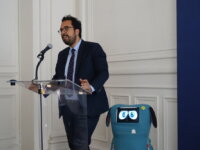
The active-waiting robot was developed by the French local-level Seine Saint Denis Innovation Lab. We created the robot R2-D3 to help reduce the digital gap with Departmental Home for Disabled Persons (Maison départementale des personnes handicapées) users. It informs users on various topics in a playful and simplified way. It can speak and understand many languages, which is useful in the context. And it can also collect data from users.
It is user-oriented and it's built upon new robotic…

This blog was written by Nicolas Zahn, Former Consultant, Digital Government Team at the OECD At a recent OECD Conference, speakers from various backgrounds joined forces to discuss what role public policy plays in supporting the development and implementation of Artificial Intelligence (AI) to benefit societies. Although we are standing at the beginning of a transformation, AI already has an impact on our everyday lives and hence complex questions arise from data governance over labour...