
The Australian government is transforming employment services to improve how the system works for job seekers, employers and the community.
Transformational change requires genuine consultation to capture the diversity of views of stakeholders affected by changes, identifying pain points, testing ideas and laying the groundwork for sustainable policy reform.
A citizen centric approach helps to understand the real-world impact, leading to better outcomes and greater acceptance in the community.
Innovation Tag: Public Policy
Community Connects is a pilot project that came out of the Transportation Innovation Lab. Problem/Opportunity: Cape Breton Regional Municipality (CBRM) is a region with high levels of poverty and unemployment. Innovation: Taxi service, doorstep pick-up, defined drop-off points, flat rate: $7 seat. Why innovative? In short, the approach (social innovation lab) and those that were engaged (first-voice participants).
Case Study
Partnering for success: a regional monitoring system for social equity and inclusive development
A multistakeholder partnership created a regional indicators-based monitoring system to track pro-poor health policy change across the Southern African Development Community (SADC), a low-income region beset by socio-economic costs of a high disease burden. This stimulated SADC’s Result-Based Regional Monitoring and Evaluation initiative. Extending to all SADC priority areas, Results-Based Monitoring and Evaluation (RBME) enables real-time tracking of regional performance, documentation of…
Case Study
Redesigning the federal homelessness program: engaging people with lived experience of homelessness
As part of the engagement process on the redesign of Canada’s homelessness program, Employment and Social Development Canada engaged directly with people with lived experience of homelessness. Dedicated tools and mechanisms were developed to ensure the meaningful participation of people with lived experience, the removal and mitigation of financial barriers to engagement and recognition of the unique expertise and knowledge of people with lived experience.
Canada has an obligation to protect and inform migrant workers of their rights while in Canada and to support employer compliance with the conditions of its Temporary Foreign Worker Program. To this end, it launched the Migrant Worker Support Network pilot initiative. The Network is a collaborative and migrant worker-informed platform for migrant workers, employers, governments, and civil society to develop and implement solutions to better protection and support of migrant workers in Canada.
Employment and Social Development Canada (ESDC) led the design and implementation of a national poverty reduction strategy public engagement process. We offered Canadians multiple ways to share their views, from public town hall events to online discussions, to a youth contest, to an in-depth research project. The engagement process successfully reached thousands of Canadians in a short time frame on a low budget. The plan is now used as a Government of Canada model for effective civic…
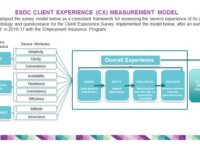
The Client Experience Measurement Survey Model was developed by Employment and Social Development Canada to gather and analyse client feedback to improve service delivery to its clients. Canadians have been able to express their views on government programs and services, which have informed the way programs and services are designed and delivered. The survey allows the tracking of service satisfaction, ease of access, effectiveness of service delivery, and the experience of particular programs…
The Indigenous Early Learning and Child Care (ELCC) Framework is innovative because it represents a promising practice in the development of a comprehensive policy, program and implementation strategy that was co-developed with the Government of Canada and Indigneous peoples. The document recognizes the value of Indigenous-led, culturally-grounded programs and that supports their health and wellbeing, spiritual, social and educational development, and language and culture.
Case Study
Construction of an experimental and co-creation research methodology for co-operative governance in…

The prolonged economic crisis in Europe has led to a growing feeling of alienation among citizens from the main decision-making centres. The co-creation research methodology for co-operative governance is an innovative approach to stakeholder engagement in which policymakers and researchers work as a team in dialogue spaces configured to address different territorial challenges. A participative, open and collaborative governance for the economic development of Gipuzkoa is therefore being built.

EUIPO studies show that young people are lacking information on intellectual property, and the available information is presented in an ineffective way for the specific age group. Starting the new 2018/2019 school year in Latvia, general education, academic secondary education and vocational secondary education teachers will have the opportunity to integrate intellectual property issues in their lessons, thus contributing to the formation of a responsible and innovative new generation.