
TCS is part of the Government Data Architecture initiative to enable secure data sharing and usage across public service, built upon an integrated data management framework that manages the data lifecycle effectively from acquisition to destruction. It is a one-stop central sensor data platform that provides end-to-end data sharing services with exploitation environment.
Case Study Library
Where innovations are collected and shared to disseminate and replicate good ideas

Innovations:
0
This website, as well as any data and map included herein, are without prejudice to the status of or sovereignty over any territory, to the delimitation of international frontiers and boundaries and to the name of any territory, city or area.
Case Study
Farishte Dilli Ke – Empowering Citizens Through Accessible and Reliable Emergency Healthcare…
Farishte Dilli Ke (Hindi for Saviours of Delhi) uses innovative fiscal and non-fiscal incentives to encourage citizens to become Good Samaritans by helping victims of road traffic accidents, thermal burns and acid attacks without the fear of legal hassle or police enquiry. Under this scheme, the victims receive cashless treatment at any registered public or private nursing home or hospital across Delhi benefitting more than 18,919 people in the last 5 years.

KSPO has created the SOLF, Seoul Olympic Legacy Forum as a platform where Olympic legacy entities from all around the world gather for the first time to share and collaborate on sustainable development plans for the Olympic Legacy. Through the SOLF, Olympic legacy entities communicated and cooperated with each other to solve the long-term social problems after the Olympic games and to deliver intangible legacy of Olympic spirit and world peace to future generations.

Seocho-gu is the first district in Korea to offer a service like the “Seocho BookPayback Service” (hereafter, “BookPayback”), which reduces the waiting time for popular library books. A full refund is provided for a book purchased from a local bookstore that is returned (to the bookstore) within three weeks, after which the book is sent to a library in Seocho-gu. It is an innovative library service that allows residents to use library resources whenever needed, regardless of time or…

The Carbon-Free Island JEJU by 2030 (CFI 2030) policy aims to transform Jeju into a carbon-free island by 2030. It is the first project in the world to target an area with a population of over 500,000 and has been ongoing since 2012. Home to the UNESCO-designated Biosphere Reserve (2002), World Natural Heritage Site (2007), and Global Geopark (2010), Jeju strives towards a carbon-neutral future utilizing state-of-art technology including renewable energy, EV, smart grids, and microgrids.

New Zealand wants our small businesses to be the most digitally enabled in the world. Digital Boost helps owners and employees to build confidence and skills to digitally transform their businesses. Cynefin complexity theory, agile programme development, and public-private partnerships are used to deliver easily accessible learning and services. This includes bespoke playlists of video content, online diagnostic tools, peer-learning support and free or discounted digital equipment or services.…
A proof of concept has been created to incorporate design techniques in many elements of a PoD's life cycle, planning for future demands and overcoming existing hurdles. The proposed strategy prioritizes the needs of persons with disabilities and helps them acquire the resources and services they need. It also helps families gain confidence in caring for a disabled kid. This helps POD engage, lead, create, and sustain life.
Trend Atlas is a digital, interactive platform with rich insights on local and global trends and emerging signals to inform strategic planning, policy development and service redesign. It reduces research time, rework and duplication by breaking down information silos with centralised data and evidence. Built by policy people who upskilled in digital, it combines automation and curation with a sustainable contributor model to create a collaborative and trusted strategic intelligence service.
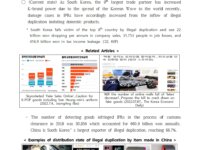
The project is subject to uncovering illegal duplication in advance from overseas inflow through the AI Reading System in the process of customs clearance cooperated with Korea Customs Service. No. of uncovering illegal duplication per annum exceeds 400,000 cases and the demand for AI system is high due to lacking manpower for customs inspection and the explosive increase in importing goods. This AI system has been developed from 2020, and proving its performance in two customs office in Korea.
In response to the Australian Government’s National Blockchain Roadmap the Blockchain Excise Platform digitises and tracks a taxable commodity (in this case pure litres of alcohol). It connects producers and regulator with real-time access to new data, generating productivity benefits and reducing illicit activity. A first of its kind blockchain ecosystem connecting the regulator to industry to more effectively control the movement, transfer and payment of liabilities for an excise commodity.