
Where organisations in the criminal law domain used to originally operate in a chain, things changed when a different approach to dealing with common crimes was adopted. The police, the Public Prosecutor's Office, victim support, and the probation service are all based at one single location, enabling them to handle complete cases within a time span of only nine hours. With this new working method, cases are kept simple, settled quickly, handled together, and treated as selectively as possible.
Case Study Library
Where innovations are collected and shared to disseminate and replicate good ideas

Innovations:
0
This website, as well as any data and map included herein, are without prejudice to the status of or sovereignty over any territory, to the delimitation of international frontiers and boundaries and to the name of any territory, city or area.
Case Study
The Energy and Resources Factory – a collaborative venture by the joint Dutch water boards
The Energy and Resources Factory is a collaborative venture by the Netherlands’ 21 water boards. It is an organization that is focused on turning wastewater into a source of renewable energy and resources.
The South Holland provincial authority is looking for ways to make the energy transition towards carbon neutrality a standard consideration in all its infrastructure management and maintenance activities. The province wants innovation to be a structural part of these activities, which has already produced the ‘N211 generates energy’ and ‘N470 generates energy’ projects.
The former municipality of Molenwaard was the Netherlands’ first local council to operate without a town hall. This innovation came about when three local authorities merged together into one municipality. Despite becoming a much larger municipality they still wanted to stay close to the community. They decided to no longer have a service desk in the traditional sense of the concept. Instead, the local authority goes out into the community and is, therefore, always nearby.
How do we create a safer river delta while at the same time ensuring an attractive living environment? This is the question that the Dutch Directorate-General for Public Works and Water Management (Rijkswaterstaat) sought to answer through its Room for the River program. With this program, the emphasis was shifted from reinforcing dikes to creating more space for the river, with an unprecedented focus on the spatial quality of the whole river delta.
Since 1 January 2013, the regional social services unit for the Drechtsteden area in the Netherlands’ South Holland province has been procuring domestic support based on performance agreements with care providers. By putting performance first, instead of the number of hours of support provided, care providers are incentivized to work more efficiently. The new method comes with benefits for users, for the Drechtsteden region, and for care providers.
The municipality of Zuidhorn (now Westerkwartier) created the Child Package, based on the principles of Blockchain. The Child Package is a scheme intended for children from low-income households. Residents can log in on a website and use a QR-code to pay for child products at participating regional businesses.

The GovTech Lab is a public sector team focused on encouraging the creation and use of innovative solutions for the government. The GovTech Lab helps the public sector identify challenges that can be solved with emerging technologies, engages startups and SMEs, creating innovative solutions and accelerating startups in #GovTech and #TechForGood space.
Case Study
Putting Users First: An Innovative Approach to the Modernization of the Heating Assistance Rebate…
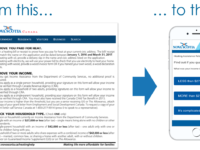
The Heating Assistance Rebate Program (HARP) helps over 42,000 low income Nova Scotians with the high cost of heating their homes in the winter. In 2016 Service Nova Scotia used an innovative approach to modernize HARP from a paper-based application to an online system to improve user experience and government processes. The modernization of this program was uniquely user-driven with significant user-testing leading the transition process and continuous user-testing for ongoing improvement.
The digital economy is booming in Medellín. So is digital tax evasion. To identify potential tax evaders, the local treasury department used to detect unregistered online stores manually. Since the use of social media for economic activities has grown exponentially, the agency has now developed a bot that automatically scrapes Instagram for such stores - and officers can use their time instead to work with store owners to formalize their businesses.