
The Regione Emilia-Romagna has, since 2014, developed a pilot strategy to promote and coordinate the use of social media by local police departments.
Keeping in touch with citizens is the core business of every local police, but today, traditional communication tools and skills are not enough to respond to citizens' needs and demands.
As such, we established a network of people inside local police departments to share expertise in the area of social media.
Innovation Tag: Citizen Engagement
The Michigan Economic Development Corp (MEDC) teamed up with private partner Patronicity to launch a first of its kind crowd-granting program to help create vibrant communities throughout Michigan. The program revolutionizes the granting process, in part, by making the community the final review committee. If the project garners enough community support through crowdfunding, it will receive a matching grant.
With crowdfunding success rates across the industry at around 5-10% for projects…
Rede Bem Cuidar (Well Caring Network) is a network of Local Health Units, each acting as a multi-generational social hub. We developed the project to improve the quality of public health services offered to the city of Pelotas’ citizens, establishing community participation as a precondition for unfolding the project. The resulting renovations are designed to improve healthcare facilities and services, support employee well-being and create much-needed community space.
The service concept is based on findings in two previous studies in the field of social housing conducted in Sarpsborg: The findings showed that our municipal services were fragmented and complex. But, they also showed that the number of homeless in Sarpsborg was lower than the average on a regional and national scale.
Housing conditions are of importance for people’s lives, health development. We decided to do more of what we did well, and improve it. This brought about the project Way Home.
The reason for the development and launch of our e-solutions was to facilitate the collection of initiatives and proposals to eliminate administrative burdens and review their implementation in one place.
Our innovation provides users with an on-line one-stop-shop solution, where they receive all information about activities in eliminating administrative burdens and preparing better legislation, and enables systematic collection, resolution and monitoring of implementation of proposals.

Two decades ago, 80% of Indonesia’s timber exports consisted of illegally-sourced wood. In order to combat this problem and to promote more sustainable forest management, the Government of Indonesia developed an innovative multi-stakeholder approach to ensure that wood products and raw materials would only be obtained or come from sources whose origins and management were legal and sustainable. Thus, the Timber Legality Assurance System (Sistem Verifikasi Legalitas Kayu – SVLK) was born.
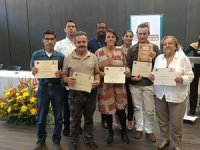
In a context where the channels between institutions and citizens have been broken by corruption, Día Blanco [White Day] is developed to promote bonds of trust and legitimacy among communities. In the last 3 years, more than 35,000 citizens have been mobilized by this innovative experience, which helps social organizations to inform their communities about their management and impact on local development through social accountability exercises.
Seoul Metropolitan Government (SMG) announced the as a measure to enhance the city’s age readiness by supporting the younger elderly. The plan is one of the SMG’s social innovation model that has transformed towards the convergence of public policies to utilize the 50+generation as a meaningful social capital to cope with the city’s aging issues.
The South Saskatchewan River Basin Adaptation to Climate Variability Project (SSRB Adaptation Project) brought together those who know the region’s water systems best to look for opportunities to further enhance the resiliency of the Bow and Oldman-South Saskatchewan river basins in southern Alberta.
The ground-breaking 100,000 Genomes Project is a highly ambitious programme that has established the UK as the global leader in genomic medicine. Focussing on rare diseases and common cancers, the Project provided a proof of concept for establishing a fully integrated Genomic Medicine Service in the UK National Health Service, the first health service in the world to offer whole genome sequencing for some conditions.