
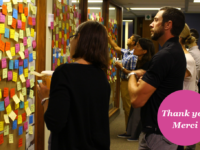
The OEE established a Social Innovation "UnLab" (SIU) to test an embedded innovation model and amplify energy efficiency policy and service impacts in Canada. The SIU creates value for energy efficiency stakeholders in three ways:
Building relationships and capacity for energy efficiency policy and service innovation;
Generating evidence and collective learning by co-creating and testing insights and interventions;
Amplifying impacts by scaling learning and implementing what works.
Case Study Library
Where innovations are collected and shared to disseminate and replicate good ideas

Innovations:
0
This website, as well as any data and map included herein, are without prejudice to the status of or sovereignty over any territory, to the delimitation of international frontiers and boundaries and to the name of any territory, city or area.
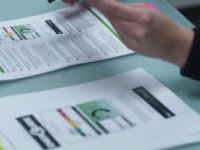
A first of its kind (in our context), cross-jurisdictional partnership between three levels of government to research, co-design and test prototypes with citizens to inform and improve the experience and uptake of home energy efficiency labeling and reporting.
The core team was comprised of representatives from Natural Resources Canada’s (NRCan) Office of Energy Efficiency (OEE), the Province of Alberta’s CoLab, and the City of Edmonton with service design support from Situ Strategy.

In May 2016, the Mayor of San Francisco launched the Safe and Clean Neighborhoods Promise. This was a new initiative to improve the quality of life in San Francisco with a coordinated approach to delivering City services better and faster. He issued an Executive Directive to Department Heads responsible for quality of life issues directing them to prioritize services so all residents have access to clean, safe, maintained public spaces and facilities. To ensure success, the mayor created the…

In Argentina, public servants are getting promoted according to their innovation level. To support this initiative, The Design Academy for Public Policy teaches public servants how to innovate. At the Academy, we teach the core skills and innovative tools public servants need to acquire in order to solve future public challenges, and at the same time empowers them to be part of a cultural change within the government.
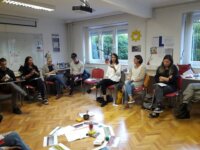
The challenge the city Ljubljana wanted to address was how to approach young people who have ideas. What works well, and what could be even better? City Incubator is a programme for the implementation of the ideas of young people in Ljubljana. It is a sustainable tool for implementation and co-financing of local youth initiatives. Individuals or groups may put ideas forward and in the frame of the programme, they receive professional support for the fine-tuning, and financial support for the…

For the first time in India, over 100 million citizens have been conferred a legal right to grievance redress. The Bihar Right to Public Grievance Redressal Act also provides a no-wrong door policy (every complaint compulsorily received in any centre in Bihar or digitally and acknowledged) and power parity between citizens and public authority (specially mandated independent, quasi-judicial officers provide a one-stop solution after weighing evidence from both sides).
Case Study
Vitamin Lab: How to Take Citizen Responsiveness and Integrity in Health Services to the Next Level

The innovation was developed to tackle the problem of corruption in the Lithuanian healthcare sector. We conducted a Vitamin Lab experiment to find out if the change of the clinic’s environment indirectly affects the behaviour of patients, how it can influence their attitudes towards the clinic, increase transparency and reduce bribery. To our knowledge, it was one of the first initiatives to use this type of measured social design interventions in the context of healthcare sector corruption.

ProZorro is a hybrid electronic government e-procurement system created as the result of a partnership between business, government and the civil society in Ukraine. Innovative public procurement system delivering government services in a stakeholder-focused, transparent, fair and low-cost way. In two years of operation of ProZorro saved $1.9 billion of budget funds and became a leader in openess of goverment data on public procurement.
ProZorro.Sale is an electronic auction system aimed at transparent sales of state and local government assets. It involves a central database that conducts auctions and stores all the information about the transaction and commercial platforms connected to the database via Application Programming Interface (API). After the transaction all the information becomes public.
With the complex service system, it is difficult to help young people with numerous problems. The MY LIFE working method is a co-created, human service integration for young adults, complete with case management, a survey assessment, and an ePlatform.