
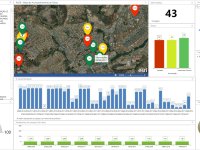
The Environmental Sanitation Company of the Federal District of Brazil uses of spatial intelligence to reduce water consumption, increase revenues and optimize process.
Case Study Library
Where innovations are collected and shared to disseminate and replicate good ideas

Innovations:
0
This website, as well as any data and map included herein, are without prejudice to the status of or sovereignty over any territory, to the delimitation of international frontiers and boundaries and to the name of any territory, city or area.
The Price Bank enables public procurement parties to have points of reference for price quotes for particular products, as it is a database of electronic invoices issues in Brazil. Participants narrow their search via descriptors and filters to find the right quote.
SPID (Sistema Pubblico di Identità Digitale, or Digital Identity System) is a solution for accessing public administration online services through once-only digital identity (user & password) generated by private Identity Providers. It can be used from any device (PC, tablet & smartphone) by citizens. SPID aims to improve the relationship between citizens & the public administration by expanding the digital approach in using public services.
SmartStart was the first cross-agency online life event service in New Zealand. SmartStart makes it easier for New Zealanders to access information and services around the birth of a child.
New Zealanders can:
1) learn about having a child;
2) navigate government services;
3) access and engage with services; and
4) consent to reuse information provided to one agency with another agency.
A multi level interdiscipline municipality model was created in order to improve the level of service and treatment provided to the targeted population. The aim of the model is to reduce the time of the homelessness of the young adults at risk and speed the transfer from "reaching out" and detection to treatment and rehabilitation.
The purpose of this app is to alert citizens, especially the ones with health problems, about the current and near-future conditions at their current location. This app is linked to complex algorithms developed by scientists at Masdar Institute using real-time satellite data and weather forecasting models. This app issue warnings on air quality and dust concentration to the public and especially to asthma-effected population. Real-time data is updated each 15 min.
Forest fires affect many parts of Southeast Asia, resulting in extensive environmental destruction, health problems, school closures and transport cancellations. Haze Gazer is a web‐based decision support system for disaster management authorities which harnesses multiple sources of data to provide insights on haze disaster dynamics.
City of Things initiative is an open innovation environment where different actors are gathered within a unique innovation infrastructure and research service in which new technologies (with a focus on Internet Of Things) are being explored, shaped and tested in a citywide living lab setting. Hundreds of smart sensors and wireless gateways positioned at carefully selected locations across streets and buildings will transform the city of Antwerp into a true living lab for the IoT.
The Republic of Estonia is the first country to offer e-Residency— a transnational digital identity available to everyone in the world interested in managing a location-independent business. E-Residency enables secure and convenient digital services that facilitate credibility and trust online.
Challenges facing the public sector are constantly evolving and managers increasingly require rapid access to talent to meet short timelines. Despite this, we still rely heavily on permanent hiring. In this context, we are testing a new workforce model. In this model, public servants are free to choose work that matches their skills and interests and can be rapidly deploy to work on projects.