

The Free Education platform is an open and collaborative learning space that seeks to awake the interest of Brazilian youth in their personal and professional development. It is a free, open platform, and its practical, interactive content is especially directed at lower income youths (between the ages of 16-24), that have not completed high school and do not have the necessary skills to find employment or interest in continuing their studies through formal education.
Country: Brazil
Hearing the people's demands and points of view, through reliable sources, is a central challenge to governance in the 21st Century. With no additional costs, we use the government's call center, representative scientific samples of the population, and up-to-date computer-assisted telephone interviewing to uncover popular evaluations of the quality of public services in Brasilia, Brazil.
Rede Bem Cuidar (Well Caring Network) is a network of Local Health Units, each acting as a multi-generational social hub. Incorporating a community engagement process that involved local representatives, UBS staff, and community members. The resulting renovations are designed to improve healthcare facilities and services, support employee wellbeing, and create much-needed community space.
The Brazilian Open Data Policy established processes and responsibilities so that the federal executive branch of government open data in a systematic, planned, sustainable and resilient manner, that can survive to a radical change in politics. Integration with access to information and ombudsman processes have also ensured that citizens have a formal channel to participate.
Case Study
Enhancing civic engagement in high school students through online gamification: the case of…
Brazil has faced many corruption scandals, which is causing Brazilians, and mainly its youth, to increasingly distrust public institutions in general. A a result, we launched "Cities in Play", a free online game to be played in schools that puts the students in the position of an elected mayor, who needs to choose among different public policies to make his best to succeed in his administration. Our main goal is to enable political awareness in Brazilian youth to allow them to play an active…
The Open Data Policy of the Federal Executive Branch was established by the Decree N. 8.777/2016. Besides establishing the possibility of requesting public databases, the policy sets up the obligation for each body to draw up an Open Data Plan (PDA), which systematizes the planning for the opening of public data. The CGU monitors (through www.paineis.cgu.gov.br/dadosabertos) around 230 federal agencies covered by the decree, establishing regular and customized contact with public managers.
Services Guide is a response to the scattered and inefficient information on public services available, developed as an open data digital catalogue, that together with an artificial intelligence software provides personalised information to the user while collecting data about citizen’s needs at the same time.
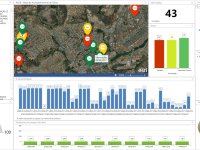
The Environmental Sanitation Company of the Federal District of Brazil uses of spatial intelligence to reduce water consumption, increase revenues and optimize process.
The Price Bank enables public procurement parties to have points of reference for price quotes for particular products, as it is a database of electronic invoices issues in Brazil. Participants narrow their search via descriptors and filters to find the right quote.
As one of Open Government Partnership’s co-founders, Brazil has developed a new co-creation methodology to define the commitments of its National Action Plans (NAP). It has envisaged co-creation workshops with parity participation of experts from government and civil society in chosen themes. The initiative aimed to conciliate the watchful eye of civil society’s representatives and the technical eye of those actors who live the reality of the state administrative machinery to set…