

LAB Justice is the first executive education program, tailor-made for the Justice sector. With a customized learning journey, it was designed to help people working for Justice bodies address the challenges faced to deliver more efficient and people-centred services. Focused on three main areas – strategic management, digital transition and leadership in a context of change –, it aims to ensure the necessary skills to implement reform measures, namely those under the Recovery and Resilience…
Innovation Tag: Leadership
Aboriginal Children in Australia are 11.5 times more likely to be placed in out of home care then non-Aboriginal Children. Marram-Ngala Ganbu is an Aboriginal designed and delivered Court based program that seeks to provide a more effective, culturally appropriate and just response for Aboriginal families through a court process that enables greater participation by family members and culturally-informed decision-making.

Covid-19 outbreak and the new reality led to increase in the demands for remote health services. The health system faced with an adaptive challenge of redesigning remote health services in no time. The Digital Health Department at the Israeli Ministry of Health founded a cross-organizational and cross-professional health practitioners’ community to advance wide scale, informed and safe telemedicine practices through the creation of a learning environment, knowledge sharing, and joint action.

In the VUCA (volatility, uncertainty, complexity and ambiguity) world, the tasks of the government are interconnected and require cross-border collaboration and dialogue within ecosystems. However, one of the key challenges is the lack of knowledge and easy-to-deploy tools. As partners of Work2.0Lab (Työ2.0Lab), we co-created and implemented Ecosystem School 1.0. Its purpose was to develop ecosystem thinking, capabilities and tools to support phenomenon-oriented work within ecosystems.

The Accountability Incubator is a creative peer learning program for young civic activists and change-makers who want to fight corruption and build accountability. It was developed to provide long-term support, networks and skills to people who are often overlooked by or left out of traditional civil society programs. It is innovative in that it uses creative tools, a long-term approach and the very latest thinking to shape governance globally.

Customer-oriented public services direct the authorities to look at citizens from their own responsibilities without taking into account a citizen’s overall life situation. A human-centric and life event -based operating model supported with the life-event service ecosystem technology enables the authorities to produce value directly in people's life events through the cooperation of other service providers in a timely and proactive manner.

The Future Mentors programme is a reversed mentoring programme in which a small group of young people mentor a decision maker from their own city about the hopes, dreams, and fears of the young generation regarding the future of their city. The programme is a platform for youth in cities to get into a dialogue with the decision makers and get their concerns and wishes heard. Twenty-six cities around Europe participated in the programme in 2022.

We can agree on a lot more than we are led to believe. PolicyKeys is firstly a robust one-page narrative tool built around a ground truth so an AI can assist in predicting support for any public policy solution. PolicyKeys is secondarily a role-playing game to help player's better understand their own internal conflicts, as well as better understand their fellow citizen's differing beliefs—the result is a leaderboard of ideas that have deep and wide acceptance—approaching consensus.
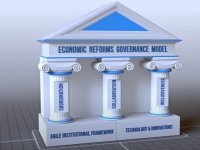
An Economic Reform Governance Model to reform design and delivery of citizen-and business-centric public services was introduced in 2016. Aim of the Model was to eliminate barriers, ensure transparency, develop digital public services and expand competitiveness through increasing engagement of civil society and businesses in the reform process. Implementing 136 reform initiatives by passing 55 legal acts enabled the government to create more favorable social-economic opportunities for citizens.

This is an account of how managers became enthused and took responsibility for leading change and co-creating it with their staff within the Planning service. The approach they took was in stark contrast with their standard and legislative based thinking and obvious digital solutions. They incorporated new management behaviours and team working. Waste was dramatically cut, and the staff environment created a highly motivating culture. The impact of the customers needs was profound.