
Skip to content
An official website of the OECD. Find out more
Created by the Public Governance Directorate

This website was created by the OECD Observatory of Public Sector Innovation (OPSI), part of the OECD Public Governance Directorate (GOV).

How to validate authenticity

Validation that this is an official OECD website can be found on the Innovative Government page of the corporate OECD website.

View as: Map

Filter by:

Countries

Level of government

Sector

Year of launch

Stage of innovation

Recognition

Innovation Tags

Innovations:
0
This website, as well as any data and map included herein, are without prejudice to the status of or sovereignty over any territory, to the delimitation of international frontiers and boundaries and to the name of any territory, city or area.
MAGMA Indonesia is an system that streamlines the process of geological hazard mitigation. It raises the bar on the standard of data monitoring and management for Indonesian government agencies. MAGMA digitizes relevant geological data into integrated databases, making them easier to analyze and use. Frequent readings and analytics can now be made ready in an almost-real-time manner. As a public service, MAGMA makes geological hazard mitigation and assessment available for free, anytime and…
G2C (Government-to-Citizen), a cross-sectoral public service delivery innovation in Fiji, employs mobile units to deliver socio-economic and legal services to the vulnerable in remote areas. Fostering public agency interconnectedness, this innovation adopts a systemic approach, with efficiencies for citizens. A mobile app, the Start-to-Finish Service Delivery Tracker (S2F), is being developed.
The system in the Kolding Municipality in charge of providing medical benefits underwent a comprehensive design driven innovation process aiming for better and more efficient service in 2015. Min Plan gives citizens an intuitive understanding of the medical benefit system, just as it empowers them to take responsibility for their own case, making it a successful journey through the system. The results currently show a 38% reduction in complains from citizens and 3 million euro saved a year.
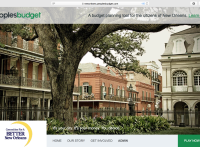
The People’s Budget is an interactive, mobile-friendly website that demystifies local spending by asking residents to play "mayor for a day" by balancing their city budget. Users learn more about how government works and how it spends money before deciding for themselves how to divide discretionary funds. The answers to these questions are synthesized and reported back to the community and city leaders to help get limited tax dollars to the programs that need them the most.
A collaboration between government and community, Systemic Design eXchange (SDX) is an Edmonton-based community of practice for people interested in learning about systemic design as a methodology for addressing complex, real world issues. Together, we explore systems thinking, design thinking, and change lab approaches. With a bias towards learning by doing, SDX aims to be a watering hole where multiple sectors can come together, learn together, and act together.
The Korean government has implemented a program dubbed the One-stop Customized Lifecycle Services (OCLS) for heirs and expectant mothers, which was created by integrating existing services. With the OCLS in place, people no longer have to visit multiple government offices and they can take care of various issues at once. The government has also benefited from reduced costs and plans to emulate this success in other areas.
The National Secretariat of Technical Planning in Paraguay created the first National Volunteer Program Arovia, a public volunteer platform that promotes increased access to information on public services and opportunities for the implementation of grassroots projects that strengthens citizen participation and local governments structures. Arovia volunteers are young professionals who bring innovative social interventions to territories prioritized within the national poverty reduction strategy.