
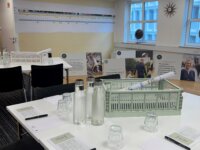
This project aimed to translate new legislation on occupational injuries into a citizen-oriented service journey, helping those injured at work to re-enter the workforce through education. Through co-creation, we designed the future customer journey, designing a unified service that involved various stakeholders.
Country: Denmark
Hospital-care-associated infections (HCAIs) represent the most frequent adverse event during care delivery, affecting hundreds of millions of patients around the world. Implementing and ensuring conformity to standard precautions, particularly best hand hygiene practices, is regarded as one of the most important and cheapest strategies for preventing HCAIs. The behavioural sciences have documented the potential of adjusting seemingly irrelevant contextual features in order to ‘nudge’ people…
The Center for Hybrid Intelligence (CHI) has with partners such as UN’s AI4Good and the Danish People Climate Summit piloted a new AI powered game, “Crea.visions,” which allows the general public to collaboratively create and reflect on images of possible futures. Such accessible crowdsourcing of the concerns and solutions of the general public on both global and local complex socio-scientific problems could form a cornerstone in participatory democracy in the digital age.
The Innovation Barometer is the world’s first official statistics on Public Sector Innovation (PSI), now implemented in 5 countries, providing innovators and decision makers with systematic knowledge of what thousands of innovators 'actually do’. The barometer advances PSI as a tool for solving societal problems and is used in practice for: inspiring innovation work, policymaking, strategising, executive leadership development, teaching, research and consultancy services.
The project improves quality of life for people with a chronical illness by developing and integrating digital solutions in the education of patients. It supplements the physical training but replaces the traditional education in a health centre and offers patients a far more flexible solution. Patients can participate in webinars from home and chat with healthcare professionals and other patients. The use of digital solutions results in both resource optimization and patient empowerment.
“TAKO – Moms” is the result of a project with the goal of developing a Minimum Viable Product to help tax administration service workers with customer service. TAKO is an online overview of all customers, which was created by the service workers themselves in collaboration with programmers. This process resulted in both exceptional improvements in the payment of VAT’s as well as large evolutions in the skills of the workers, without launching a high-cost project.
CORO, Co-lab is the result of an ambitious vision of creating innovative collaborations. The local innovation platform creates new sustainable solutions to complex societal challenges. It takes place in cross-sectorial cooperation’s between public organizations, academia, civil society and businesses across industries. Through the activities, new sustainable scalable solutions are developed, using the entire area of Roskilde as a unique real-life test platform with demonstration facilities.
In response to the COVID19 crisis, the Danish Government has published data and statistics on a daily basis.