
Latvia’s E-index is the first national-level initiative helping central government institutions and municipalities to evaluate and recognize their level of digital transformation, foreseen solutions and learn from other institutions. This enables and motivates the development of the e-environment. Within the spirit of positive competition, the common goal is raising awareness of digital transformation, learning about policy and tools, and increasing quality and accessibility of services to…
Innovation Tag: Open Government
In order to rebuild the relationship between the administration and its stakeholders, the Chamber of Commerce of the Italian city of Cosenza has initiated project #OpenCameraCosenza. To achieve this objective, #OpenCameraConsenza rearranged the organizational and communication structures and together with the legal representative, the communications team used different tools to reach the administration's stakeholders: Facebook, Twitter, Instagram, Aurasma app, Qr-codes and the website.
The Northern Ireland (NI) Public Sector Innovation Lab has organised a hackathon, “Hack the Pain,” to address these needs of an underserved group: people with persistent pain. These individuals need for better information services for self-management, and the projects that emerged from the hackathon include a virtual reality app for mindfulness, a pain tracking app and a website of information on pain management techniques.
LawMaker is a lobby for the lobbyless – a free advocacy tool for those of us who don’t have a professional working for them to influence our governments. LawMaker allows Americans to (1) crowdsource ideas for new laws, (2) build voter coalitions, and (3) engage politicians to advocate for change. Our mission is to democratize democracies by empowering the creation of new laws that originate from real people at the grassroots, instead of from lobbyists and wealthy special interests.
En 2015, le Parlement de Wallonie a engagé une réforme de son Règlement ayant notamment pour objectif d’associer davantage les citoyens wallons au travail législatif des députés.
Dans ce cadre, plusieurs dispositifs ont été mis en place dont la plateforme "Un décret par tous, un décret pour tous" qui vise à encourager les citoyens à intervenir directement dans la rédaction d’un décret sur base d’une problématique soulevée par un député.
Open policy-making is an opportunity for government and stakeholders to move from linear, polarized, single-issue, interest-based considerations to interactions that are networked, collaborative, opportunity-based and where complexity is viewed as an asset. Adapted for the Government of Canada context, Pol.is is a cost-effective and highly scalable, digital engagement platform that can be used as part of broader strategies to put people and robust evidence at the heart of government decisions.

The Youth Olympic Games Buenos Aires 2018 had as an objective to be organized in an open and transparent manner. As a result, the Olympic Legacy initiative was created to ensure relevant and timely access to information to all local stakeholders in regards to the event and its organization. This platform brought open government tools at the heart of the development of a global sports event. It had a significant impact in terms of promoting open data, higher quality data standards, improved…
The frameworks for creating and managing the rule of government, as reflected in policies, legislation and regulation, are still based on a paper paradigm. In a digital world this creates poor service experiences and often the intent of a policy is not achieved. Instead if we co-design authoritative machine-consumable rules we can provide better services for citizens, better delivery of policy intent, and enable communities, NGOs and private sector to be part of a government service ecosystem.
The Administration of Rome had to decide how to use about 17 million euros for public works in the territory of the VIII District for projects concerning the environment, landscape and public green spaces, sustainable mobility and accessibility, urban regeneration and infrastructure, ideas or proposals for transversal projects. The innovation concerns the decision-making approach. For the first time, city users were involved in deciding how to allocate these resources.
Case Study
Unlocking the potential of crowdsourcing for public decision-making with artificial intelligence
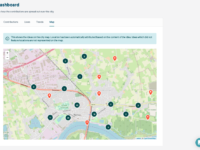
In citizen participation projects, analysing contributions is often a huge challenge for administrations.
CitizenLab has developed machine-learning algorithms in order to help civil servants easily process thousands of citizen contributions and efficiently use these insights in decision-making.
The dashboards on our platform classify ideas, show what topics are emerging, summarise trends and cluster similar contributions by theme, demographic trait or location.