
In June 2017 the Government created a Social Innovation and Social Finance Strategy Co-Creation Steering Group (SG) to provide recommendations for a Strategy. Based on a year-long process the SG developed 12 recommendations.
In response, the Government announced the Strategy’s foundational elements in November 2018 including a $50 million Investment and Readiness program to build the capacity of organization to access social finance and a $755 million repayable Social Finance Fund.
Country: Canada
The Client Centric Policy Playbook strengthens the ability to engage clients in the design of program and service policies.
Through extensive engagement with policy experts and employees on-the-ground, the Playbook has brought together innovative best practices, tools and resources for engaging clients.
This solution enhances client experience by giving clients an opportunity to be part of the policy generation process and by ensuring that programs and services are reflective of their needs.
Case Study
Future Skills: Engaging governments and stakeholders to build a skills development ecosystem
Future Skills is part of the Government’s plan to build a resilient and confident workforce that reflects Canada rapidly evolving nature of work. It embraces user-centred design principles to inform the adoption of proven practices and evidence on skills development approaches, to ensure that Canada’s policies and programs are prepared to meet Canadians’ changing needs. It was designed in collaboration with provincial and territorial governments, and informed by a large range of…
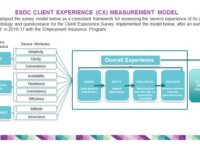
The Client Experience Measurement Survey Model was developed by Employment and Social Development Canada to gather and analyse client feedback to improve service delivery to its clients. Canadians have been able to express their views on government programs and services, which have informed the way programs and services are designed and delivered. The survey allows the tracking of service satisfaction, ease of access, effectiveness of service delivery, and the experience of particular programs…
The Indigenous Early Learning and Child Care (ELCC) Framework is innovative because it represents a promising practice in the development of a comprehensive policy, program and implementation strategy that was co-developed with the Government of Canada and Indigneous peoples. The document recognizes the value of Indigenous-led, culturally-grounded programs and that supports their health and wellbeing, spiritual, social and educational development, and language and culture.
Transport Canada has piloted the use of Artificial Intelligence (AI) to perform risk-based oversight by scanning Pre-loading Advance Cargo Information (PLACI) to identify potential air cargo threats (i.e. “bomb-in-a-box” scenario). By using AI to perform this function, there is potential for Transport Canada to save 1,000’s of hours and conduct risk assessments on all air cargo shipments coming from abroad -- in real-time.
Open policy-making is an opportunity for government and stakeholders to move from linear, polarized, single-issue, interest-based considerations to interactions that are networked, collaborative, opportunity-based and where complexity is viewed as an asset. Adapted for the Government of Canada context, Pol.is is a cost-effective and highly scalable, digital engagement platform that can be used as part of broader strategies to put people and robust evidence at the heart of government decisions.
Canada Beyond 150 was an experiment in leadership development for a diverse cohort of new public servants, with the goal of encouraging a culture shift to a more open and innovative public service. Working in groups part-time over a year, participants learned foresight, design thinking and external engagement methods and applied them to complex policy issues, with a focus on diversity and inclusion. It demonstrated the power of experiential learning, especially from engagement with stakeholders.
Case Study
Integrating Design and Behavioural Insights to increase the take-up of an education savings program…
The Canada Learning Bond, a government education savings program providing a financial incentive to low income Canadians, turned to behavioural insights (BI) to tackle persistent low take-up. Following unsuccessful BI trials based on academic literature and expertise, we turned to Design. In a Government of Canada first, combining lessons learned from human centred design processes including stories from citizens and BI we developed outreach that significantly improved the take-up of the Bond.
Experimentation Works (EW) is a Government-of-Canada initiative to build public servants’ capacity in experimentation skills and practice through a learning-by-doing model that supports and showcases 5 small-scale experiments in the open. EW seeks to generate practical examples of experiments and ensure open access to learning materials, progress updates and results for broad impact. It works by connecting project teams with each other, and with experts in a open-by-default “cohort model."